Canalblog Tous les blogs Top blogs Musique & Divertissements Tous les blogs Musique & Divertissements
Suivre ce blog Administration + Créer mon blog
MENU
Garbage's Box
Publicité
4 juillet 2018

Rock & Folk , Juin 2018

2018-06-rockfolk-n611  Rock & Folk
n°611
pays magazine: France
paru le 16 juin 2018
article de 2 pages sur Garbage 

> visuel article
2018-06-rockfolk-n611-p16  


GARBAGE
En 1998, le groupe de Shirley Manson triomphait avec son deuxième album.
L'Ecossaise évoque ici ce rock technoïde devenu vintage.

Isabelle Chelley


IL Y A 20 ANS, "Version 2.0" annonçait le retour d'un groupe qui avait affolé les esprits et la critique dès ses débuts. Non content d'avoir enchaîné les hits avec sa formule chanteuse-parolière belle à forte tête / trois producteurs / son entre électro et rock, Garbage brouillait encore les pistes, un pied dans le futur, l'autre dans le passé.

Tempes rasées et queue de cheval rouge
On débuterait bien l'interview, mais l'attachée de presse a dit à Shriley Manson qu'on avait un chien. Et la chanteuse de Garbage, tempes rasées et queue de cheval rouge, gilet en moumoute et robe noire, regarde ses photos sur notre téléphone.
"J'adorerais être un chihuaha, dit-elle avec un de ces éclats de rire franc qui ponctuent la conversation. Ma chienne est un croisé chihuaha et Jack Russell, elle vit comme une reine." En attendant une reprise d' "I Wanna Be Your Dog", on aborde le sujet qui nous amène à Londres: ce processus de rééditions débuté en 2015. "C'est une idée de notre manager. Ca peut avoir l'air arrogant, mais il estimait qu'on devait ressortir ce disque pour montrer ce qu'on avait fait. Ca a été si bien en tournée qu'on en a fait autant pour "Version 2.0". Ces disques nous ont donné la liberté d'enregistrer aujourd'hui.
Ses souvenirs de la création de "Version 2.0" sont glaçants. "On a passé l'hiver à Madison à travailler. Les lacs étaient gelés, on avait de la glace dans les narines en rentrant du studio le soir. Et je me souviens de notre assurance. On sortait d'un premier album au succès énorme. J'avais 30 ans et les mecs du groupe la quarantaine. Avoir cette chance aussi tard dans une carrière, c'est extraordinaire."
On évoque la presse de 1998, ses titres sur la belle et les geeks, la poupée manipulée par les vieux briscards. "C'est fou comme on a pu me considérer comme un objet. Je voulais qu'on me voie comme une artiste. J'ai écrit autant de choses sur les disques que le groupe, j'avais autant d'idées de production qu'eux... Les mentalités changent lentement. Quand Debbie Harry est arrivée, elle a été une pionnière pour nous toutes. C'est l'archétype de la chanteuse pop moderne qui a pulvérisé tous les murs. J'ai une énorme gratitude envers elle. Il n'y aurait pas de Madonna sans elle. Et sans Madonna, pas de Beyoncé. Et sans Beyoncé, où serions-nous ?" conclut-elle en éclatant de rire. En 2017, les Américains ont pu voir les deux pétroleuses partager une scène quand Blondie et Garbage ont tourné ensemble. Shirley précise que sa première rencontre avec Debbie Harry remonte à 1984, à Liverpool quand elle jouait avec Goodbye Mr Mackenzie.
"Son manager m'a dit: 'Je te trouve incroyable, si un jour tu sors un disque, fais-moi signe'. Il a cru en moi avant tout le monde, il a changé ma vie. En raison de ce lien, Debbie et moi étions souvent sur les mêmes labels, aux mêmes fêtes. Elle est venue me voir en première partie des Ramones à New York, elle était dans la fosse. La tournée a été fantastique pour un million de raisons, surtout, parce qu'en tant que femme de 51 ans dans la musique, je suis souvent la plus vieille dans la pièce. Et soudain, je me retrouvais en tournée avec une femme de 71 ans ! C'était très rare d'avoir des représentations de femmes plus âgées dans les médias. Elle montait sur scène tous les soirs avec énergie, sex-appeal, esprit punk, elle reste d'une beauté incroyable. Mon groupe perdait les pédales quand elle leur parlait. Personne n'est aussi cool qu'elle."

Le plafond de verre
Dans le genre modèle cool, la fille qui débutait "Version 2.0" en annonçant qu'elle était un loup déguisée en mouton n'était pas mal non plus. "C'était une façon de dire, ne me prenez pas pour une fillette parce que je porte une jolie robe, vous ne savez pas qui je suis." Malgré tout, les années 90 ont été un âge d'or où il faisait bon être une grande gueule plutôt qu'une poupée. "J'ai aimé cette période, mais tout n'était pas idéal. La musique de l'époque me manque. Il y avait une telle liberté pour les femmes. A un certain moment, ma génération s'est dit qu'elle cassait le plafond de verre. Ce n'était pas vrai, hélas."
Avant de prendre congé, on lui demande ce qu'elle aurait fait si elle n'avait pas connu le succès avec Garbage. "J'ai longtemps voulu être actrice, mais je n'ai pas pu entrer dans un cours d'art dramatique. J'ai travaillé 5 ans dans une boutique de vêtements avant de réussir à m'échapper dans un groupe. J'ai foutu en l'air ma scolarité. vraiment. Aujourd'hui encore, mon père me dit: "Tu aurais dû aller à la fac". Je lui réponds: "Papa, je suisune rock star, j'ai du succès...

Publicité
16 mars 2017

06/07/2016 WISN abc Wisconsin

Strange Little Birds Promo


 6 juillet 2016
Web Video WISN abc Milwaukee news - USA

Interview Shirley Manson

> l'interview video sur wisn


A l'occasion de leur concert donné au Summerfest à Milwaukee, dans le Wisconsin, Shirley est interviewée par la télé locale.

> captures
2016-07-06-wisn_abc-cap01 2016-07-06-wisn_abc-cap02 2016-07-06-wisn_abc-cap03 
2016-07-06-wisn_abc-cap04 2016-07-06-wisn_abc-cap05 2016-07-06-wisn_abc-cap06 
2016-07-06-wisn_abc-cap07 2016-07-06-wisn_abc-cap08 2016-07-06-wisn_abc-cap09 


Shirley Manson of Garbage recalls band's Wisconsin roots
> online musicwaves

2016-07-06-wisn_abc-photo01  MILWAUKEE — It wasn't Shirley Manson's first time at Summerfest Wednesday. The lead singer of Garbage took the Harley-Davidson Roadhouse stage that evening alongside her bandmates.
Manson said it's been wild since the band started in Madison and recorded their first four albums in Dairyland.
"This whole state of Wisconsin is engrained in my life and in ways that I couldn't possibly have fathomed 20 years ago, like people obsessed with the Green Bay Packers ... I have to be. My band are diehard fans," Manson explained.
Garbage hit the big time after recording "Only Happy When it Rains" in the nineties.
The group even composed the theme song for the James Bond film, "The World Is Not Enough."
These days, the band is touring a new album and recently performed on "Jimmy Kimmel Live!
Though it's possible to tell Manson hails from Scotland, she is all too familiar with Wisconsin winters.
"It's taxing when you come from a really moderate climate like Scotland, to come her and experience what you guys experience," she said. "You guys are tough, tough."
She had just a few parting words before taking the stage for her show at the Big Gig: "Go Pack, go!"


© All images are copyright and protected by their respective owners, assignees or others.
copyright text by GinieLand.

Enregistrer

Enregistrer

14 octobre 2016

Garbage: Empty

Strange Little Birds 


2016 
Empty
premier single
chanson n°2 de l'album


Enregistrement: La chanson est extraite du sixième album studio du groupe, sorti le 10 juin 2016 sur le label indépendant Stunvolume et dont l'enregistrement et la composition a pris deux ans, entre 2013 et 2015.

Composition: Selon Shirley Manson: "Empty is just exactly what it says it is. A song about emptiness". ("Empty est exactement ce qu'il dit qu'il est. Une chanson sur le vide."). Pour Butch Vig, la chanson est du pur et classique Garbage, avec ses riffs de guitare et les battements de batterie.

Paroles
I've been feeling so frustrated
I'll never be as great as I want to be
Everyone that I run into
The ones you always seem so into
What's wrong with me ?

They all seem to know exactly what it is they want
They pass me, they smile as they go
So I work at staying patient
Good things come to those that wait
Or so they say

I'm so empty
You're all I'm thinking about, about
Oh oh, about, about
Oh oh oh, about, about

I get tired of trying
Ideas die on the vine
And I feel like a fake
I lie awake believing
That somehow I keep failing
I rail and I ache
At the monsters and the demons
I've wrestled with for eons
And I want to destroy

I'm so empty
You're all I talk about
Oh oh oh, about
You're all I talk about

Every day, every hour of the night
You're all I think about
Every day, every hour of the night
You're all I dream about
Every day, every hour of the night
You're all I think about

I'm so empty
I'm so empty
I'm so empty
You're all I'm thinking about
About, about, oh oh oh, about
I'm so empty

Traduction
Je me suis sentie si frustrée
Je ne serai jamais aussi génial
que je veux l'être
Chaque personne que je rencontre
Ceux sur lesquelles tu sembles toujours être
Qu'est-ce qui ne va pas avec moi ?

Ils semblent tous exactement savoir
ce qu'ils veulent, ils me dépassent
Ils sourient en partant
Donc je m'emploie à rester patiente
Les bonnes choses viennent à ceux qui attendent
Ou alors ils disent

Je suis si vide
Je ne pense qu'à toi

Je suis fatiguée d'essayer
Les projets meurent sur la vigne
Et je me sens comme fausse
Je reste éveillée croyant
Que d'une manière ou d'une autre je continue à échouer
Je m'entoure d'une barrière et j'ai mal
Aux monstres et aux démons
Contre lesquels j'ai lutté depuis le temps
Et que je veux détruire

Je suis si vide
Tu es tout ce dont je parle

Chaque jour, chaque heure de la nuit
Je ne pense qu'à toi
Chaque jour, chaque heure de la nuit
Tu es tout ce dont je rêve
Chaque jour, chaque heure de la nuit
Je ne pense qu'à toi

Je suis si vide
Je ne pense qu'à toi
Je suis si vide.


Le single: Le single, sorti uniquement en format digital, était disponible sur les plateformes de téléchargement dès le 20 avril 2016.
Le groupe a annoncé la sortie du single sur leur compte Twitter le 16 avril:

2016-04-16-garbage_twitter-empty 

Dans les charts: le titre atteint la 39ème place dans le US Alternative Songs de Billboard (aux Etats-Unis).


Le clip vidéo: Le clip est réalisé par Samuel Bayer, à qui l'on doit les premiers clips vidéos du groupe (Vow, Only Happy When It Rains et Stupid Girl, extraits de leur premier album éponyme "Garbage" en 1996). Dévoilé le 23 mai 2016, la vidéo reprend d'ailleurs le même contexte que leur premier clip "Vow" de 1995, sans doute car le groupe a repris les codes musicaux de leur premier album pour leur grand retour («Pour moi, ce disque, assez bizarrement, a plus à voir avec le premier qu’avec nos albums plus récents. Il revient à cet état d’esprit du début.» a commenté Shirley Manson); dans la vidéo, on y voit donc le groupe jouer la chanson dans une grande pièce au sol bétonné (comme pour "Vow"); mais ici, ils sont éclairés de spots de lumières de différentes couleurs (qui nous rappelent la vidéo de "Milk"), et où les caméras tournent vite autour d'eux, à 360 degrés, pendant que Shirley Manson secoue ses cheveux roses, filmée au ralentie.

> vidéo

> captures
garbage-video-album_6-empty-cap01 garbage-video-album_6-empty-cap02 garbage-video-album_6-empty-cap03 
garbage-video-album_6-empty-cap04 garbage-video-album_6-empty-cap05 garbage-video-album_6-empty-cap06 
garbage-video-album_6-empty-cap07 garbage-video-album_6-empty-cap08 garbage-video-album_6-empty-cap09 
garbage-video-album_6-empty-cap10 garbage-video-album_6-empty-cap11 garbage-video-album_6-empty-cap12 
garbage-video-album_6-empty-cap13 garbage-video-album_6-empty-cap14 garbage-video-album_6-empty-cap15 
garbage-video-album_6-empty-cap16 garbage-video-album_6-empty-cap17 garbage-video-album_6-empty-cap18 
garbage-video-album_6-empty-cap19 garbage-video-album_6-empty-cap20 garbage-video-album_6-empty-cap21 
garbage-video-album_6-empty-cap22 garbage-video-album_6-empty-cap23 garbage-video-album_6-empty-cap24 
garbage-video-album_6-empty-cap25 garbage-video-album_6-empty-cap26 garbage-video-album_6-empty-cap27 
garbage-video-album_6-empty-cap28 garbage-video-album_6-empty-cap29 garbage-video-album_6-empty-cap30 
garbage-video-album_6-empty-cap31 garbage-video-album_6-empty-cap32 garbage-video-album_6-empty-cap33 
garbage-video-album_6-empty-cap34 garbage-video-album_6-empty-cap35 garbage-video-album_6-empty-cap36 
garbage-video-album_6-empty-cap37 garbage-video-album_6-empty-cap38 garbage-video-album_6-empty-cap39 
garbage-video-album_6-empty-cap40 garbage-video-album_6-empty-cap41 garbage-video-album_6-empty-cap42 
garbage-video-album_6-empty-cap43 garbage-video-album_6-empty-cap44 garbage-video-album_6-empty-cap45 
garbage-video-album_6-empty-cap46 garbage-video-album_6-empty-cap47 garbage-video-album_6-empty-cap48 
garbage-video-album_6-empty-cap49 garbage-video-album_6-empty-cap50 garbage-video-album_6-empty-cap51 
garbage-video-album_6-empty-cap52 garbage-video-album_6-empty-cap53 garbage-video-album_6-empty-cap54 
garbage-video-album_6-empty-cap55 garbage-video-album_6-empty-cap56 garbage-video-album_6-empty-cap57 
garbage-video-album_6-empty-cap58 garbage-video-album_6-empty-cap59 garbage-video-album_6-empty-cap60 
garbage-video-album_6-empty-cap61 garbage-video-album_6-empty-cap62 garbage-video-album_6-empty-cap63 
garbage-video-album_6-empty-cap64 garbage-video-album_6-empty-cap65 garbage-video-album_6-empty-cap66 
garbage-video-album_6-empty-cap67 garbage-video-album_6-empty-cap68 garbage-video-album_6-empty-cap69 
garbage-video-album_6-empty-cap70 garbage-video-album_6-empty-cap71 garbage-video-album_6-empty-cap72 
garbage-video-album_6-empty-cap73 garbage-video-album_6-empty-cap74 garbage-video-album_6-empty-cap75 
garbage-video-album_6-empty-cap76 garbage-video-album_6-empty-cap77 garbage-video-album_6-empty-cap78 
garbage-video-album_6-empty-cap79 garbage-video-album_6-empty-cap80 garbage-video-album_6-empty-cap81 
garbage-video-album_6-empty-cap82 garbage-video-album_6-empty-cap83 garbage-video-album_6-empty-cap84 
garbage-video-album_6-empty-cap85 garbage-video-album_6-empty-cap86 garbage-video-album_6-empty-cap87 
garbage-video-album_6-empty-cap88 garbage-video-album_6-empty-cap89 garbage-video-album_6-empty-cap90 
garbage-video-album_6-empty-cap91 garbage-video-album_6-empty-cap92 garbage-video-album_6-empty-cap93 
garbage-video-album_6-empty-cap94 garbage-video-album_6-empty-cap95 garbage-video-album_6-empty-cap96 
garbage-video-album_6-empty-cap97 garbage-video-album_6-empty-cap98 garbage-video-album_6-empty-cap99 
garbage-video-album_6-empty-cap100 garbage-video-album_6-empty-cap101 garbage-video-album_6-empty-cap102 
garbage-video-album_6-empty-cap103 garbage-video-album_6-empty-cap104 garbage-video-album_6-empty-cap105 
garbage-video-album_6-empty-cap106 garbage-video-album_6-empty-cap107 garbage-video-album_6-empty-cap108 

> Sur le tournage - captures
garbage-video-album_6-empty-set-making_of-cap01 garbage-video-album_6-empty-set-making_of-cap02 garbage-video-album_6-empty-set-making_of-cap03 
garbage-video-album_6-empty-set-making_of-cap04 garbage-video-album_6-empty-set-making_of-cap05 garbage-video-album_6-empty-set-making_of-cap06 
garbage-video-album_6-empty-set-making_of-cap07 garbage-video-album_6-empty-set-making_of-cap08 garbage-video-album_6-empty-set-making_of-cap09 
garbage-video-album_6-empty-set-making_of-cap10 garbage-video-album_6-empty-set-making_of-cap11 garbage-video-album_6-empty-set-making_of-cap12 
garbage-video-album_6-empty-set-making_of-cap13 garbage-video-album_6-empty-set-making_of-cap14 garbage-video-album_6-empty-set-making_of-cap15 
garbage-video-album_6-empty-set-making_of-cap16 garbage-video-album_6-empty-set-making_of-cap17 garbage-video-album_6-empty-set-making_of-cap18 
garbage-video-album_6-empty-set-making_of-cap19 garbage-video-album_6-empty-set-making_of-cap20 garbage-video-album_6-empty-set-making_of-cap21 
garbage-video-album_6-empty-set-making_of-cap22 garbage-video-album_6-empty-set-making_of-cap23 garbage-video-album_6-empty-set-making_of-cap24 

> photographies
garbage-video-album_6-empty-set-2016-04-10s-instagram-1  garbage-video-album_6-empty-set-instagram 
garbage-video-album_6-empty-set-by_lindsey_byrnes-1  garbage-video-album_6-empty-set-fb 

> making of


La promo- Performances télés - Le groupe a interprété à ce jour le titre en live dans une seule émissions TV -en France- (rdv dans la catégorie 2016 Promo Strange Little Birds ):

> C à Vous - 25 mai 2016


> Sur le web:
article Empty wikipedia 


 © All images are copyright and protected by their respective owners, assignees or others.
copyright text by GinieLand.

2 octobre 2016

Liberation, 3/04/1996

garbage-mag-1996-04-03-liberation-n4625-france  Liberation

pays journal: France
date 3 avril 1996


Garbage, âge tendre et grabuge. Réponse ricaine à la «fast-pop» anglaise, Shirley et sa bande jouent à Paris. Garbage, en concert ce soir à l'Elysée-Montmartre, Paris; album: «Garbage», BMG.

Le fantasme pop a failli tourner au cauchemar. A l'automne dernier, Butch Vig, fameux producteur du Nevermind de Nirvana, était en carafe dans sa retraite du Wisconsin. «Au bord de la dépression nerveuse», précise-t-il. Les crises succédaient aux crises, plus rien ne tournait rond. Garbage, le groupe formé avec deux complices producteurs du Midwest, Duke Erickson et Steve Marker, et une fille d'Ecosse, Shirley Manson, menaçait de n'être que ce qu'on pouvait en attendre: un rêve inerte d'ingénieur du son.

Après quelques mois de tensions devant la console et l'accueil bienveillant réservé au disque, la perspective des concerts ébranlait l'édifice. «A l'origine, Steve, Bruce et moi-même n'avions pas pensé que nous monterions un jour sur scène, raconte Vig. Nous voulions juste former notre propre groupe pour aller au bout des idées qu'on ne pouvait réaliser en travaillant pour les autres, mélanger des idées de tous bords ­ techno, hip hop, grunge, funk, ambient ­ dans le contexte d'une chanson pop. Nous avons multiplié les expériences en studio pour trouver une texture particulière mais quand nous avons voulu prouver au monde que nous étions un bon groupe, c'est devenu une autre histoire.» Premières répétitions catastrophiques; «nul et banal», concède le producteur.

Pour sa première visite française, lors des Transmusicales de Rennes en décembre, Garbage commençait toutefois à sortir du moule. Le son compact, la densité mélodique, la voix et l'abattage d'une Shirley Manson aussi culottée que ses modèles (Chrissie Hynde, Siouxsie) produisaient leur effet dans le palais des sports bétonné où Nirvana s'était imposé. Les trois cerveaux du Midwest et leur imprévisible compagne sont depuis retournés à Madison. Trois semaines de répétition, une mise au point technique et technologique. Et des progrès annoncés: «Nous avons maintenant des instruments qui nous permettent de réutiliser et de réarranger sur scène les boucles et les samples du disque et de prolonger l'expérience, dit Butch Vig. La maîtrise de cette technologie nous permet de jouer en toute décontraction. Enfin presque...»

Le cas Garbage n'a jamais été simple. Il prend sa source dans la frustration de trois malins («Smart» est le nom de leur studio) persuadés de pouvoir trouver la parfaite équation pop en croisant leur formation de musiciens et leur expérience de producteurs.

Butch Vig, fils d'une professeur de musique et batteur branché sur Keith Moon depuis les années lycée, s'est forgé une réputation en apurant et canalisant les tentations bruitistes de la vague grunge (Nirvana, Sonic Youth, Smashing Pumpkins...), ses deux compères-guitaristes ont bossé sur des remixes de U2, Nine Inch Nails, Depeche Mode. «Quand on nous demandait ce genre de travail, raconte l'homme de Nevermind, on ne pouvait s'empêcher d'effacer les pistes pour réenregistrer les instruments. On réécrivait les chansons.» L'envie de composer est venue naturellement. Le trio a repris le fil d'une passion qui les tenait depuis l'adolescence. Ils étaient alors tellement impressionnés par la pop expérimentale du Roxy Music première formule qu'ils avaient formé un genre de fan-club. Ils ont suivi cette piste. Ne leur manquait qu'une voix pour asseoir leur idée. Pas de crooner en vue: ils ont cherché une femme.

La première rencontre avec Shirley Manson, starlette underground au passé corbeau-gothique, a tourné au désastre. Après une prometteuse conversation, l'ex-chanteuse de Goodbye Mr McKenzie et d'Angel Fish, repérée sur MTV, s'est révélée sans voix ni idées lors de l'audition. «On était déçus, raconte Butch Vig. On cherchait une personnalité, capable d'apporter sa patte aux compositions. On voulait éviter le piège évident, la faute que tout le monde guettait: enrôler une créature qui mettrait sa voix au service de nos idées. Mais après le premier essai, elle nous a rappelés, elle avait des propositions à faire et l'envie de nous convaincre. La plupart des textes que nous avons enregistrés ce jour-là ont tenu jusqu'au dernier mix de l'album.» Shirley Manson existe à présent. Au-delà de leurs espérances. La brunette donne corps au groupe sur les planches et en coulisses. Mi-louve, mi-virago. La presse anglaise se régale de ses déclarations à l'emporte-pièce, de ses accès lubriques et de ses aventures scato-rocambolesques. Parfois, elle stoppe net le cinéma et la provocation: «Ma mère m'a prévenue que j'allais finir par passer pour une vraie crétine!»

«A vrai dire, on ne s'attendait pas à un tel personnage, dit Butch Vig. Elle ne nous correspond pas du tout. Elle est caractérielle, elle réagit au quart de tour, alors que nous sommes très pragamatiques, que nous réfléchissons des heures avant de prendre la moindre décision.» Aux premiers jours, l'équipage menaçait d'imploser. Les trois alchimistes brouillaient les pistes à loisir, traquaient tous les accidents possibles, mélangaient trente pistes de guitares pour n'en faire qu'une. Ils avaient tous une idée assez tranchée (et rarement consensuelle) sur les directions à suivre. La chanteuse avançait à l'instinct avec des bribes de mélodies classiques.

L'incompréhension et l'impatience ont accouché de séances électriques, menaces de rupture et pugilats à peine contrôlés. Vig: «Nous carburons à la tension.» Ils en ont tiré quelque chose: un disque taillé pour le succès; une simplicité de façade, minée de l'intérieur. Pretenders ou Cranberries revisités par un Spector des 90's: «L'assurance de la voix de Shirley, son penchant pour une musique et des textes plus universels nous ont permis de pousser les expériences sur le son. Pour l'album suivant, nous prendrons sans doute plus de risques.» Ils parlent du producteur idéal: Spector, Eno, Captain Beefheart, Tom Waits... Galéjade? «Je ne vois pas comment cohabiter. Mais travailler avec Eno serait un rêve.»

Vig ne veut pas reprendre son job de producteur. Les propositions affluent toujours («Maintenant, on me demande du Garbage, plus du Nirvana!»); mais le plan de carrière est fixé: tournée jusqu'à l'automne, puis compositions et enregistrement pour l'été 1997. Garbage est là, semble-t-il, pour un moment: «Si j'entendais parler d'un groupe de producteur, disait Butch Vig au Melody Maker, je me dirais: quel putain d'egomaniaque! Mais Garbage n'est pas mon projet. C'est une collaboration psychotique et dysfonctionnelle

10 septembre 2016

16/06/2016 i>Télé

Strange Little Birds Promo


 16 juin 2016
Télévision i>TELE - France

Interview Shirley Manson
enregistrée le 13/04/2016 à Paris


Contenu: C'est toute guitare dehors que Garbage signe son retour, après quatre ans, son nouvel album. Pourtant, pas question de se fondre dans le moule de la pop. Le paysage musical actuel ne les correspond pas et ils comptent bien marquer leur différence.
Shirley Manson: "Comme notre premier album, ce n'est pas un disque léger. C'est encore nous contre le monde. Nous nous sentons en contradiction avec le monde qui manque de certaines valeurs, dans lesquelles nous, nous croyons, et qui sont absentes de la culturelle actuelle."
Des valeurs de solidarité, d'acceptation. Si le message est enrobé dans un écrin ténébreux, Garbage promeut des idées positives.
Shirley Manson: "Cela parle des gens, du fait que nous voulons tous la même chose, vraiment, au fond de nous; mais au final, nous n'arriverons jamais à marcher dans la même direction pour obtenir ce que nous voulons: être toléré et compris."
Avec ses cheveux roses, difficile de croire que Shirley Manson va bientôt souffler ses cinquante bougies. Les années semblent lui avoir apporter un peu de recul et de paix intérieure.
Shirley Manson: "Quand j'y repense, j'étais monstrueuse avec moi-même, vraiment horrible, je ne me pardonnais rien, je voulais ressembler à un top-model. Souvent, on pense que l'on n'a pas ce qu'il faut pour être heureux, mais c'est faux, ce que vous êtes est suffisant."

> captures
2016-04-13-i_tele_interview-cap01 2016-04-13-i_tele_interview-cap02 2016-04-13-i_tele_interview-cap03 
2016-04-13-i_tele_interview-cap04 2016-04-13-i_tele_interview-cap05 2016-04-13-i_tele_interview-cap06 
2016-04-13-i_tele_interview-cap07 2016-04-13-i_tele_interview-cap08 2016-04-13-i_tele_interview-cap09 
2016-04-13-i_tele_interview-cap10 2016-04-13-i_tele_interview-cap11 2016-04-13-i_tele_interview-cap12 

  > video


© All images are copyright and protected by their respective owners, assignees or others.
copyright text by GinieLand.

Enregistrer

Publicité
17 septembre 2016

Isthmus, March, 8, 1996

1996-03-isthmus-usa  Isthmus - n°35
The Weekly Newspaper of Madison

pays magazine: USA
date March, 8, 1996

> article on isthmus.com
March 8, 1996: Garbage on the streets
Madison's pop contenders move out of the studio and into the clubs
by Tom Laskin

Butch Vig looks dazed. Garbage are getting set to embark on a three-month tour (including a sold-out show at the Barrymore Theatre on March 14), and the preparations are taking their toll. Tomorrow the local-band-made-good flies to Dallas for two more days of rehearsals, and then it's showtime. Vig, who's responsible for sampled beats as well as conventional drumwork, would like to see a couple extra hours wedged into his day.
"I still have so much work to do before we get on that plane to go to Dallas," he says, stroking his neatly trimmed Vandyke.
A hundred feet away a stageful of amps, computer-controlled lights and electronic equipment is being loaded into road cases, but he hardly notices the commotion: "Between what the other guys have loaded into their samplers and what I've loaded into the samplers... We've talked about what we want to use, but we really haven't had time to do much with it yet. Between now and when we leave we'll just be constantly loading samples."
"And, you know, we still have to mix that Vic Chestnutt cover," giggles Vig's Garbage-mate, Doug "Duke" Erikson, adding one more task to the tsunami of last-minute details.
During a long technical rehearsal at the Barrymore earlier in the afternoon, Garbage's five-member touring unit occasionally fought against sampled backing tracks until the beat buckled and broke. But overall, the practice session seemed to go well. Singer Shirley Mansion asserted herself in the mix, the band as a whole came across far more focused than it does on its self-titled major-label debut, and the lighting guy enhanced Garbage's hooky explorations of darkness and debauchery with shocking pinks and diseased greens. This was a pop thang to be reckoned with; in a few weeks, they'd roll into 1,000 seat clubs and theaters, confident they could match the alternative clones and Hootie wannabes blow for blow. Plus, thanks to the band's very '90s affection for lulling techno and dub beats, club kids would feel welcome at the party too.
Vig wants to go with the flow, wants to take the inevitable "train wrecks" in stride and put his faith in the same adrenaline rush that got him through the bands' first shaky live gigs last fall. But he can't. He's a perfectionist; that much was clear form his industry-altering production work on Nirvana's Nevermind. With his own band he's got even more to worry about.
"On one level," it's easy enough for us to play live," he says, easing back into one of the Barrymore's worn seats. "Okay, we know what the chords are and here's the basic acoustic beat. But then trying to add stuff live to give it the same feel as the record but not make it the same as the record: That's why we've been evolving. I'm still switching a lot of stuff, and the sound guys aren't sure what everyone's doing yet. It's still fun, though.
"A lot of fun," he adds, a smile flickering dimly at the corners of his mouth.
The pressure Vig's feeling isn't entirely self-imposed. Garbage are definitely a band on the cusp. Their single "Queer" made the best-of-the-year lists both here and abroad for 1995. MTV just began airing "Only Happy When It Rains, the latest "buzz clip" off the band's debut album. In Europe, bonus tracks recorded since its release are keeping Garbage in the music papers; the album itself has sold over 100,000 copies in the U.K. TV production companies and film studios are asking for soundtrack material (knowing a stinker when they saw one, the band passed on Showgirls.) And as was the case with their maiden voyage last fall, most of the upcoming dates on the U.S. leg of this tour are selling out in a matter of days.
Without question, Garbage's mix of dance, dirge and hooky, dissipated pop is a serious commercial item. And so far everything they've done was recorded right here in Madison at Smart Studios.
Though those who've watched Vig's production career blossom over the last five years probably won't believe it, Garbage weren't supposed to turn out like this. When Vig, Erikson and fellow Smart producer Steve Marker first auditioned Scottish singer Manson (Marker "discovered" her while watching videos on MTV), they were thinking about ways to expand on the remix work they'd been doing for U2, Depeche Mode and Nine Inch Nails. The subterranean art of stripping songs down to a vocal line and rebuilding them with studio gear had gotten their creative juices flowing again. Maybe they'd get some experimental dance tracks together. Or better yet, an album's worth of pop oddities that used sequencers and sampling technology as well as time-honored pop-rock instrumentation.
Thanks to Vig's work with Nivana, Smashing Pumpkins and other alternative stars, there'd probably be a decent critical attention, respectable sales. Maybe they'd even do a low-budget video.
Then the album would die after a few months, the guys from Smart would go back to producing, Manson would go back to her old band, Angelfish, and that would be that: a good time had by all. Fact is, Big and Erikson had already gotten a major taste of the music industry merry-go-round in the early and mid-'80s, first with popular local New Wavers Spooner and then with heartland rockers Fire Town. Fire Town scored a contract with Atlantic, then crashed and burned a couple years later. Cramped van tours, meddlesome producers, lukewarm support form a bicoastal employer: Neither Vig nor Erikson needed that kind of aggravation again.
So what brought Garbage out of the studio and in front of the stage lights? First there was the unexpected success of "Vow," a nasty little ditty about a dysfunctional relationship released in England in 1994 by the tiny Discordant label. Then came "Subhuman" on their current British label, Mushroom, and a string of chart success in the U.K., culminating in a an assault on the top 20 by "Queer." The release of their album in this country stimulated reasonable sales as well; more important, L.A.'s influential KROQ got behind "Vow" when it was only available as an import, then got behind "Queer" as well, guaranteeing airplay and interest in other parts of the country.
Garbage hadn't played a single live date, and already Manson was being treated as one of the fresh new faces in international pop.
Mushroom and Garbage's U.S. label, Almo Sounds, certainly encouraged the band to consider hitting the road, but live gigging didn't seem like a real possibility until they went to L.A. last year to film the video for "Vow." "We were actually playing together during the 'Vow' video," says Erikson, describing the unusual genesis of Garbage's stage act. "We had amps and Butch was playing drums and Shirley had a mike set up. We did the first take, and then we all just kind of looked at each other and went: hmmm. This is kinda cool. Maybe we should do this. I mean, we played in the studio together, but it's different when you're outside the studio and really doing it."
Vig knew that playing strings of live dates meant putting his very lucrative production career on hold. Marker and Erikson had also gotten used to earning their living in the studio, and roadwork with Garbage was by no means a sure moneymaker. Even so, fan interest and the lure of the stage made a prolonged break form the mixing desk seem like a risk worth taking. Especially for Vig, who'd spent the four years since the release of Nevermind moving from project to project for L7, Sonic Youth, Smashing Pumpkins and Freedy Johnston, among others.
"For me going on the road meant being slightly more irresponsible," Vig laughs, having come to terms with the all-nighter that looms ahead. "It's not the same as being in the studio at all. It's fun playing, especially when the crowd reacts and you meet kids who are totally into the record. They come up, say hi, maybe give you tape; it's a cool thing. Having been in the studio so much lately, it's just been good to go out and know there're really people out there and it's not just about business and numbers.
" So far the highlights of Garbage's live incarnation (L.A. bassist Daniel Schulman rounds out the lineup) were a sold0out date in London in front of absolutely manic fans and a series of radio festivals the band played on the West Coast around Christmas. The radio festivals were especially pleasant, says Vig, because they gave Garbage an opportunity to chum around with other bands. "At these festivals, there are 10 bands on the bill, and you do maybe a 20- or 30-minute set," he explains. "Then you hang out with all the other bands and it's a very loose give: Everyone's drinking beer and gossiping and watching Oasis be Oasis... In San Francisco and Seattle, Sonic Youth and the Foo Fighters were on the bill; we were just goofing around backstage, hanging out. It's just fun to see everyone in that environment."
But life on the road hasn't made Garbage complacent. While it would be easy to roll through letter-perfect readings of "Queer," pushing product and accepting automatic displays of adulation, Vig says the band very much wants to push the pop envelope. There's talk of bringing a DJ along for festivals they'll be playing in Europe this summer and backing Manson with a "clubby, dubby thing." And for this tour, Marker and Erikson have strapped on MIDI guitars, a move that allows them to switch between ordinary power chording and synthetic, very unguitarlike sounds. In the future, Vig sees himself sandwiched behind the drum kit, manipulated racks of gadgetry like some bionic being.
"I know it sounds crazy," he says, pulling up in his seat and gesturing excitedly at Erikson. "But I'd almost like to have a small studio back at the drum set where I could have more stuff to fuck around with, just so we could break into things, segue into songs.... Right now we're doing some new things, but we're really just trying to interpret the songs more from how they sound on the album without totally going into a club or dub vibe.
Emphasizing the dance element in Garbage's pop material has been no problem in Europe, where remixes by Adrian Sherwood and a variety of young DJs have been snatched up by club-savvy consumers. In America, the situation is different, and Garbage know it. Guitar rock still dominates the "alternative" scene they've been lumped into, and many kids are suspicious of electronically manipulated music, viewing at as a kind of fakery. Getting this conservative element of the American audience to come along of the ride has been a challenge.
"The shows in Europe have been a bit more exciting in some ways, because there's much more tying in of elements of techno or tip-hop or dance stuff," says Vig. "People are much more into that. They're also much more into pop. Here we don't quite fit into the 'alternative' rock thing. At least there's a certain audience that's slow to catch on, because it's not the same thing as the Offspring or Pearl Jam.
"They actually pressed up some white label remixes of 'Queer' over here," he adds. "They were getting played in the clubs, but you don't really sell a lot of 'em. I think they did a thousand. It's really just for exposure in the clubs. And how many cities really have a dance scene: Miami, Detroit, New York, L.A., Chicago? That's about it."
Converting the masses translates into more touring to build a grass-roots following, and making certain that everyone in the band is committed for the long haul. How long? Vig says there will definitely be another album, perhaps recorded as early as next fall. Before that happens, the band will have toured for a total of eight months and seen the release of a new album of B-sides in Europe.
"As long as this is interesting and we're having fun, we'll keep on doing it," says Vig. "I mean, if no one comes to the shows or buys the albums, we'd probably stop. If I can, I'd like to produce one record post-touring before doing another Garbage album, just to get away from it for a while. But I might just stay in the Garbage zone. We'll have to wait and see what feels right. Right now Garbage is 24 hours a day; it's been that way for a year." -

Madison's pop contenders move out of the studio and into the clubs


Butch Vig looks dazed. Garbage is getting set to embark on a three-month tour (including a sold-out show at the Barrymore Theatre on March 14), and the preparations are taking their toll. Tomorrow the local-band-made-good flies to Dallas for two more days of rehearsals, and then it's showtime. Vig, who's responsible for sampled beats as well as conventional drumwork, would like to see a couple extra hours wedged into his day.

"I still have so much work to do before we get on that plane to go to Dallas," he says, stroking his neatly trimmed Vandyke.

A hundred feet away a stageful of amps, computer-controlled lights and electronic equipment is being loaded into road cases, but he hardly notices the commotion: "Between what the other guys have loaded into their samplers and what I've loaded into the samplers.... We've talked about what we want to use, but we really haven't had time to do much with it yet. Between now and when we leave we'll just be constantly loading samples."

"And, you know, we still have to mix that Vic Chestnut cover," giggles Vig's Garbage-mate, Doug "Duke" Erikson, adding one more task to the tsunami of last-minute details.

During a long technical rehearsal at the Barrymore earlier in the afternoon, Garbage's five-member touring unit occasionally fought against sampled backing tracks until the beat buckled and broke. But overall, the practice session seemed to go well. Singer Shirley Manson asserted herself in the mix, the band as a whole came across far more focused than it does on its self-titled major-label debut, and the lighting guy enhanced Garbage's hooky explorations of darkness and debauchery with shocking pinks and diseased greens. This was a pop thang to be reckoned with; in a few weeks, they'd roll into 1,000-seat clubs and theaters, confident they could match the alternative clones and Hootie wannabes blow for blow. Plus, thanks to Garbage's very '90s affection for lulling techno and dub beats, club kids would feel welcome at the party, too.

Vig wants to go with the flow, wants to take the inevitable "train wrecks" in stride and put his faith in the same adrenaline rush that got him through the band's first shaky live gigs last fall. But he can't. He's a perfectionist; that much was clear from his industry-altering production work on Nirvana's Nevermind. With his own band he's got even more to worry about.

"On one level, it's easy enough for us to play live," he says, easing back into one of Barrymore's worn seats. "Okay, we know what the chords are and here's the basic acoustic beat. But then trying to add stuff live to give it the same feel as the record but not make it the same as the record: That's why we've been [evolving]. I'm still switching a lot of stuff, and the sound guys aren't sure what everyone's doing yet. It's still fun, though.

"A lot of fun," he adds, a smile flickering dimly at the corners of mouth.

The pressure Vig's feeling isn't entirely self-imposed. Garbage is definitely a band on the cusp. Its single "Queer" made best-of-the-year lists both here and abroad for 1995. MTV just began airing "Only Happy When It Rains," the latest "buzz clip" off the band's debut album. In Europe, bonus tracks recorded since the release are keeping Garbage in the music papers; the album itself has sold over 100,000 copies in the U.K. TV production companies and film studios are asking for soundtrack material (knowing a stinker when they saw one, the band passed on Showgirls). And as was the case with their maiden voyage last fall, most of the upcoming dates on the U.S. leg of this tour are selling out in a matter of days.

Without question, Garbage's mix of dance, dirge and hooky, dissipated pop is a serious commercial item. What's more, so far everything they've done was recorded right here in Madison at Smart Studios.

Though those who've watched Vig's production career blossom over the last five years probably won't believe it, Garbage weren't suppose to turn out like this. When Vig, Erikson and fellow Smart producer Steve Marker first auditioned Scottish singer Manson (Marker "discovered" her while watching videos on MTV), they were thinking about ways to expand on the remix work they'd been doing for U2, Depeche Mode and Nine Inch Nails. The subterranean art of stripping songs down to a vocal line and rebuilding them with studio gear had gotten their creative juices flowing again. Maybe they'd get some experimental dance tracks together. Or an album's worth of pop oddities that used sequencers and sampling technology as well as time-honored pop-rock instrumentation.

Thanks to Vig's work with Nirvana, Smashing Pumpkins and other alternative stars, there'd probably be decent critical attention, respectable sales. Maybe they'd even do a low-budget video.

Then the album would die after a few months, the guys from Smart would go back to producing, Manson would go back to her old band, Angelfish, and that would be that: a good time had by all. Fact is, Vig and Erikson had already gotten a major taste of the music-industry merry-go-round in the early and mid-'80s, first with popular local New Wavers Spooner and then with heartland rockers Fire Town. Fire Town scored a contract with Atlantic, then crashed and burned a couple years later. Cramped van tours, meddlesome producers, lukewarm support from a bicoastal employer: Neither Vig nor Erikson needed that kind of aggravation again.

So what brought Garbage out of the studio and in front of the stage lights? First there was the unexpected success of "Vow," a nasty little ditty about a dysfunctional relationship released in England in 1994 by the tiny Discordant label. Then came "Subhuman" on their current British label, Mushroom, and a string of chart successes in the U.K., culminating in an assault on the top 20 by "Queer." The release of their album in this country stimulated reasonable sales as well; more important, L.A.'s influential KROQ got behind "Vow" when it was only available as an import, then got behind "Queer" as well, guaranteeing airplay and interest in other parts of the country.

Garbage hadn't played a single live date, and already Manson was being treated as one of the fresh new faces in international pop.

Mushroom and Garbage's U.S. label, Almo Sounds, certainly encouraged the band to consider hitting the road, but live gigging didn't seem like a real possibility until they went to L.A. last year to film the video for "Vow." "We were actually playing together during the 'Vow' video," says Erikson, describing the unusual genesis of Garbage's stage act. "We had amps and Butch was playing drums and Shirley had a mike set up. We did the first take, and then we all just kind of looked at each other and went: hmmm. This is kinda cool. Maybe we should do this. I mean, we played in the studio together, but it's different when you're outside the studio and really doing it."

Vig knew that playing strings of live dates meant putting his very lucrative production career on hold. Marker and Erikson had also gotten used to earning their living in the studio, and roadwork with Garbage was by no means a sure moneymaker. Even so, fan interest and the lure of the stage made a prolonged break from the mixing desk seem like a risk worth taking. Especially for Vig, who'd spent the four years since the release of Nevermind moving from project to project, twisting knobs and tweaking songs for L7, Sonic Youth, Smashing Pumpkins and Freedy Johnson, among others.

"For me going on the road meant being slightly more irresponsible," Vig laughs, having come to terms with the all-nighter that looms ahead. "It's not the same as being in the studio at all. It's fun playing, especially when the crowd reacts and you meet kids who are totally into the record. They come up, say hi, maybe give you tape; it's a cool thing. Having been in the studio so much lately, it's just been good to go out and know there're really people out there and it's not just about business and numbers."

So far the highlight of Garbage's live incarnation (L.A. bassist Daniel Schulman rounds out the lineup) were a sold-out date in London in front of absolutely manic fans and a series of radio festivals the band played on the West Coast around Christmas. The radio festivals were especially pleasant, says Vig, because they gave Garbage an opportunity to chum around with other bands.

"At these festivals, there are 10 bands on the bill, and you do maybe a 20- or 30-minute set," he explains. "Then you hang out with all the other bands and it's a very loose vibe: Everyone's drinking beer and gossiping and watching Oasis be Oasis.... In San Francisco and Seattle, Sonic Youth and the Foo Fighters were on the bill; we were just goofing around backstage, hanging. It's just fun to see everyone in that environment."

But life on the road hasn't made Garbage complacent. While it would easy to roll through letter-perfect readings of "Queer," pushing product and accepting automatic displays of adulation, Vig says the band very much wants to push the pop envelope. There's talk of bringing a DJ along for festivals they'll be playing in Europe this summer and backing Manson with a "clubby, dubby thing." And for this tour, Marker and Erikson have strapped on MIDI guitars, a move that allows them to switch between ordinary power chording and synthetic, very unguitarlike sounds. In the future, Vig sees himself sandwiched behind the drum kit, manipulating racks of gadgetry like some bionic being.

"I know it sounds crazy," he says, pulling up in his seat and gesturing excitedly at Erikson. "But I'd almost like to have a small studio back at the drum set where I could have more stuff to fuck around with, just so we could break into things, segue into songs.... Right now we're doing some new things, but we're really just trying to interpret the songs more from how they sound on the album without totally going into a club or dub vibe."

Emphasizing the dance element in Garbage's pop material has been no problem in Europe, where remixes by Adrian Sherwood and a variety of young DJs have been snatched up by club-savvy consumers. In America, the situation is different, and Garbage knows it. Guitar rock still dominates the "alternative" scene they've been lumped into, and many kids are suspicious of electronically manipulated music, viewing it as a kind of fakery. Getting this conservative element of the American audience to come along for the ride has been a challenge.

"The shows in Europe have been a bit more exciting in some ways, because there's much more tying in of elements of techno or hip-hop or dance stuff," says Vig. "People are much more into that. They're also much more into pop. Here we don't quite fit into the 'alternative' rock thing. At least there's a certain audience that's slow to catch on, because it's not the same thing as the Offspring or Pearl Jam.

"They actually pressed up some white label remixes of 'Queer' over here," he adds. "They were getting played in the clubs, but you don't really sell a lot of 'em. I think they did a thousand. It's really just for exposure in the clubs. And how many cities really have a dance scene: Miami, Detroit, New York, L.A., Chicago? That's about it."

Converting the masses translates into more touring to build a grass-roots following, and making certain that everyone in the band is committed for the long haul. How long? Vig says there will definitely be another album, perhaps recorded as early as next fall. Before that happens, the band will have toured for a total of eight months and seen the release of a new album of B-sides in Europe.

"As long as this is interesting and we're having fun, we'll keep doing it," says Vig. "I mean, if no one comes to the shows or buys the albums, we'd probably stop. If I can, I'd like to produce one record post-touring before doing another Garbage album, just to get away from it for a while. But I might just stay in the Garbage zone. We'll have to wait and see what feels right. Right now Garbage is 24 hours a day; it's been that way for a year."

28 août 2016

12/04/2016 Interview Music Waves

Strange Little Birds Promo


 12 avril 2016
Web Interview Music Waves - Paris, France

Interview Shirley Manson

> captures
2016-04-12-MusicWaves_interview-cap01 2016-04-12-MusicWaves_interview-cap02 2016-04-12-MusicWaves_interview-cap03


Garbage (12 avril 2016)
Article publié le 06 juin 2016 - interview de Adrianstork
> en ligne sur musicwaves

Music Waves a rencontré un drôle de petit oiseau en la personne d'une icone du rock, Shirley Manson !

2016-04-12-MusicWaves_interview-03  

Et c'est une charmante et charmeuse Shirley que nous avons eu l'honneur de rencontrer pour une interview naturelle pour évoquer la carrière du groupe, son image et enfin ce dernier super opus témoignant que Garbage est plus que jamais de retour aux affaires...

Quelle est la question que l'on t'a trop souvent posée ?
Shirley Manson : Est-ce que tu es seulement contente quand il pleut? (Rires) (en référence à la chanson de Garbage​'Only Happy When It Rains')

Et bien, nous ne te poserons pas cette question météorologique !
Merci beaucoup! (Rires)

En revanche, tu n'en as pas assez que les gens résument ta carrière à 'Stupid Girl' ou la bande-originale du film ''Le Monde Ne Suffit Pas'' ?
Pas vraiment. Au contraire, c'est un privilège que les gens se souviennent de nos chansons.

Et puis si vous n'aviez pas eu de tubes, vous continueriez à en chercher un au lieu d'évoluer...
Si nous pouvions écrire une bonne chanson qui puisse connecter les gens ensemble, ce serait merveilleux. Nous avons fait des compromis par le passé, et avons eu des chansons à la radio. Mais ça ne nous intéresse plus maintenant.
 
Comme d'habitude, Garbage a pris son temps avant de sortir un nouvel album, ´´Strange Little Birds.´´ Qu'avez-vous fait pendant tout ce temps ?
Il n'y avait pas d'urgence. Après avoir pris un break, nous avons appris qu'il fallait profiter de la vie, nous recentrer sur nos proches.

Lorsque le groupe a été connu mondialement, nous n'avions plus de vie normale

​Ce n'était pas le cas avant ?
Lorsque le groupe a été connu mondialement, nous n'avions plus de vie normale. Nous n'avions rien dans le frigo, plus de routine. Pour nous tous, c'était devenu une quête vide de sens à la fin.
Oui, notre succès était merveilleux, c'était un privilège qui n'est pas donné à tous. Merci Dieu pour avoir permis cela (Rires). Mais en même temps, nous ne voulons pas considérer cela comme plus important que les gens que nous aimons, promener le chien, aller dans un musée, lire des livres...

Mais alors maintenant, est-ce que la vie est redevenue normale ?
Comme nous savons fait des tournées à travers le monde, il y a toujours des gens pour nous reconnaître aux quatre coins du globe. Mais moi, j'essaie en priorité d'avoir une vie normale.

Mais c'est plutôt paradoxal, car...
... (elle coupe) Je suis un paradoxe (Rires) !

Je veux seulement être moi-même et pas pour attirer l'attention

Tu dis vouloir une vie normale, mais tu as des cheveux roses et les gens intrigués finissent par te reconnaître...
Je pense que je m´habille ainsi parce que je veux être créative. J'aime ce qui sort du quotidien. Je veux vivre ma vie comme une artiste. Je me suis rendu compte que je ne voulais plus divertir les gens. Je voulais plutôt être une artiste. Je me suis rendu compte que je n'avais pas besoin de jouer le jeu comme une popstar et me laisser dicter mes conditions. J'ai des cheveux roses parce que je les aime bien et je peux m'habiller comme je veux. Je veux seulement être moi-même et pas pour attirer l'attention.

Avec "Strange Little Birds", on dirait que Garbage voulait revenir au son de ses origines, avec plus de guitares, de claviers et d'expérimentation. Après un premier album marqué par l'éclectisme, qu'est-ce qui vous a donné le sentiment de retrouver vos racines ?
Pour être honnête, je pense que ce n'était pas conscient. Nous voulions seulement nous concentrer sur les choses que nous aimions quand nous avions commencé. Je pense que c´était un instantané de ce que nous sommes, où nous sommes, comment est le monde qui nous entoure.

Sur la première piste 'Sometimes', vous surprenez les fans en installant une atmosphère claustrophobique et en la gardant,  alors que par le passé les guitares auraient déjà explosé. C´était délibéré ?
Non. C´est notre guitariste Steve Marker qui a apporté ce morceau le premier jour de l´enregistrement. Il nous l´a joué et nous avons tous ressenti de la tension. Le bassiste Duke Erikson a dit qu´il fallait commencer l´album par ce morceau. Nous étions très excités parce que c´était fantastique de débuter sur des chapeaux de roue. Nous étions tous en compétition contre Steve ensuite parce que nous savions que c´était très spécial et que nous voulions faire mieux que lui (Rires). Il a capturé une sensation assez spéciale, mais authentique, une atmosphère unique.

2016-04-12-MusicWaves_interview-01 

Le son de l'album est plus atmosphérique, froid, distant, mais en même temps catchy comme ´Empty´ ou ´We Never Tell´. Etait-ce important de trouver une balance ?
Je pense que c´est définitivement important. Nous voulons créer une certaine atmosphère, raconter une histoire en évitant d´être ennuyeux. Nous voulons faire voyager l´auditeur. Je pense que nous travaillons toujours ainsi, car nous sommes tous sur la même longueur d´onde.

Nous avons essayé de rester le plus ouvert possible, même si nous parlons beaucoup de la folie.

Pour nous qui sommes un site spécialisé dans le rock progressif, le terme voyage est important. Cela veut dire qu´il y a une ligne directrice, peut-on considérer cet album comme un concept album ?
Non, je perds ma joie lorsque les lignes sont trop rigides. Nous avons essayé de rester le plus ouvert possible, même si nous parlons beaucoup de la folie. Nous avons essayé de comprendre quelles chansons pouvaient fonctionner ensemble.

Le travail sur les paroles est plutôt remarquable, avec par exemple les paroles crues de cette chanson, qui expose des vérités désespérées, mais qui en même temps, trouve  la force pour ne pas sombrer dans le désespoir, avec le puissant crescendo final. Ce n'est jamais gratuitement sombre.
Nous sommes ténébreux, les ténèbres peuvent nous apprendre beaucoup de choses, en particulier sur la mort. Nous allons tous mourir, nous sommes tous maudits. Nous aimons regarder du côté des ténèbres, dans les abysses. Cela nous permet de rebondir : faisons tout de suite quelque chose pour être heureux. Prenons un verre, faisons une balade. La vie est courte.

Est-ce que cet album est une exploration des ténèbres à la recherche de la guérison ?
Oui !

Ta voix semble plus directe, et froide comme sur 'Blackout', mais elle est capable d'être lumineuse comme sur ´Magnetized´, voire érotique comme sur ´Teaching The Little Fingers´? C´est quelque chose que tu cherchais ?
Oui, je voulais être une bonne étudiante. Je voulais toujours apprendre. Je voulais essayer différentes approches. Nous voulons tous être entendus, alors je voulais être entendue avec différentes voix.

J´ai l´impression que je n´ai plus rien à prouver et que par conséquent je peux faire ce que je veux.

Es-tu satisfaite sur la session d´enregistrement ?
Oui, je m´en sens très fière. J´ai l´impression que je n´ai plus rien à prouver et que par conséquent je peux faire ce que je veux. Des gens apprécieront, d´autres non. Mais notre futur ne dépend plus des opinions des gens. Nous pouvons alors nous concentrer pour faire du meilleur travail et essayer de dire quelque chose sur le monde.

​L'introduction de 'Teaching The Little Fingers' est assez atypique et la chanson ressemble à une séance d'hypnose.
Oui, ça me fait penser à une musique de films. On pourrait entendre cette chanson dans un film de David Lynch. Nous voulions créer une atmosphère, commencer avec la pluie et les voitures pour laisser penser que nous étions en voyage. C'était très excitant.

​Tu as dit que cet album était romantique. Peux-tu expliquer ta définition de ce mot ?
C'est un album fragile qui reflète vraiment ma personnalité.

[Par le passé] je pense que je me protégeais. Je jouais à être plus forte, plus agressive.

2016-04-12-MusicWaves_interview-02  

Ce n'était pas le cas par le passé ?
Non, je pense que je me protégeais. Je jouais à être plus forte, plus agressive.

​Cela veut-il dire que tu te sens mieux maintenant ?
Oui. Je pense que j'ai mûri. J'ai envie d'être vulnérable. Quand je dis romantique, c'est parce que je suis aussi vulnérable, nue, quand je suis amoureuse.

Nous ne voulons plus être un groupe de pop. Nous voulons être considérés comme des artistes.

Est-ce que tu considères cette orientation comme une nouvelle étape pour le groupe, que tu as ouvert un nouveau chapitre ?
Je pense que nous avons fermé une porte. Nous ne voulons plus être un groupe de pop. Nous voulons être considérés comme des artistes.

​Comment s'est déroulé l'enregistrement ? Tu as dit en interview que la carrière du groupe était miraculeuse tant le groupe était mentalement lent...
Oui, nous sommes lents. Et je ne sais pas pourquoi, mais peut-être est-ce parce que nous ne sommes pas obsédés par la célébrité à tout prix. Nous n'avons pas de plan de carrière tout en étant ambitieux. D'autres personnes voudraient avoir encore plus de succès, mais nous n'avons pas cet appétit. Ce qui est le plus difficile c'est de trouver du temps ensemble, car nous ne vivons pas dans les mêmes villes, donc chacun doit faire beaucoup d'efforts. Et je suis chanceuse d'être avec d'autres personnes qui partagent la même philosophie que moi et qui feront toujours un jour ou l'autre l'effort nécessaire pour enregistrer.

Tu as dit que le groupe était lent, alors pouvons-nous déjà annoncer le prochain album de Garbage pour 2020 ?
(Rires) On ne sait jamais, on peut toujours changer nos habitudes.

​Le titre de cet album était inspiré par une lettre d'un fan, mais comment ces mots ont-ils eu une répercussion sur toi et sur l'album ?
Une jeune fille de 19 ans m'a donné cette lettre extraordinaire après un concert à Niji-Novgorod. C'était un essai sur ses combats, sa solitude, ses tourments. Cela a attiré mon imagination. Je pouvais sentir sa peine en lisant sa lettre sur le chemin de l'hôtel. Cela m'a inspiré pour écrire une chanson sur mes tourments. C'est le thème de la chanson éponyme.

Après avoir enregistré la chanson titre du James Bond, ''Le Monde ne suffit pas'', et joué dans ''Terminator'' et ''Knife Fight'', as-tu décidé de  poursuivre ton aventure avec le cinéma ?
Cet album est déjà très cinématographique. La première chanson n'est pas une chanson, elle est destructurée, c'est juste une sensation. J'aime le cinéma.

​Quelles sont tes attentes pour cet album ?
Je n'ai aucune attente. Sinon, je serais déçue (Rires).

2016-04-12-MusicWaves_interview-04  

Quel est ton meilleur souvenir en tant qu'artiste ?
J'en ai beaucoup. Mais peut-être la première fois que j'ai entendu une chanson de Garbage à la radio.

​Et a contrario le pire ?
Quand un producteur nous a dit qu'avec seulement un million d'albums vendu, ce n'était pas suffisant. Ce jour-là, nous avions compris que nous couchions avec le diable.

​Nous avons commencé par la question qu'on t'avait toujours posée. Mais maintenant, quelle est la question que tu voudrais que je te pose ?
J'ai l'impression que si les gens ne me posent pas certaines questions c´est parce qu´ ils ne veulent pas connaître certaines réponses.

​Où une chose que nous n'aurions pas abordé dans cette interview?
Il y en a des millions alors (Rires). 

Merci beaucoup, Shirley
(En français) "Merci beaucoup"


© All images are copyright and protected by their respective owners, assignees or others.
copyright text by GinieLand.

Enregistrer

16 juin 2016

1995 Garbage en interview 1

Garbage Album Promo


1995
Télévision MTV

une des premières interviews filmée du groupe


Groupe
Shirley Manson
Butch Vig
Steeve Marker
Duke Erikson


Captures

captures du documentaire "Thanks For Your Uhh, Support" (DVD Absolute Garbage) 

1995-interview-cap01-1 1995-interview-cap01-2 1995-interview-cap01-3 
1995-interview-cap01-4 1995-interview-cap01-5 1995-interview-cap01-6 


© All images are copyright and protected by their respective owners, assignees or others.
copyright text by GinieLand.

Enregistrer

Enregistrer

Enregistrer

15 juillet 2016

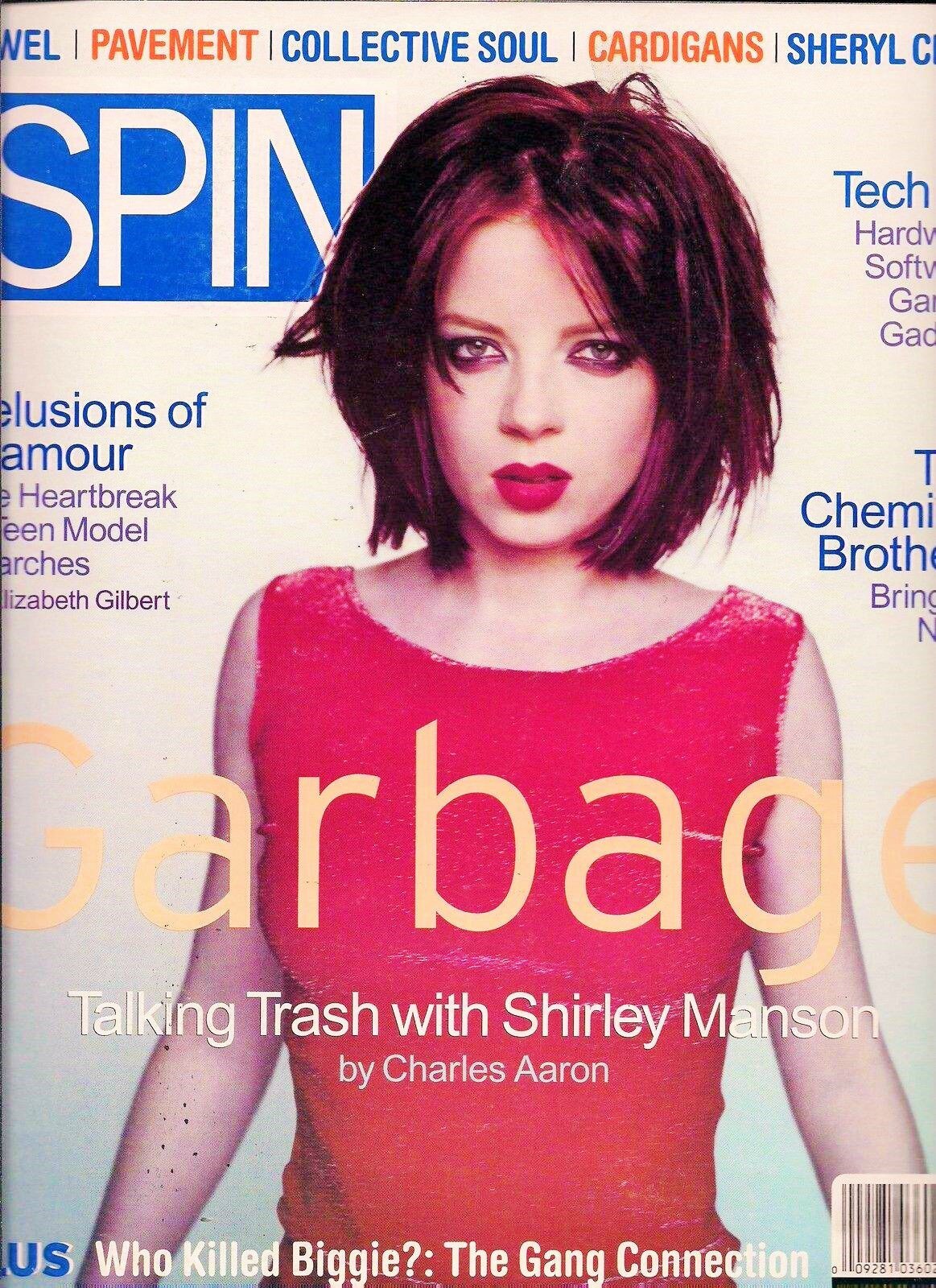
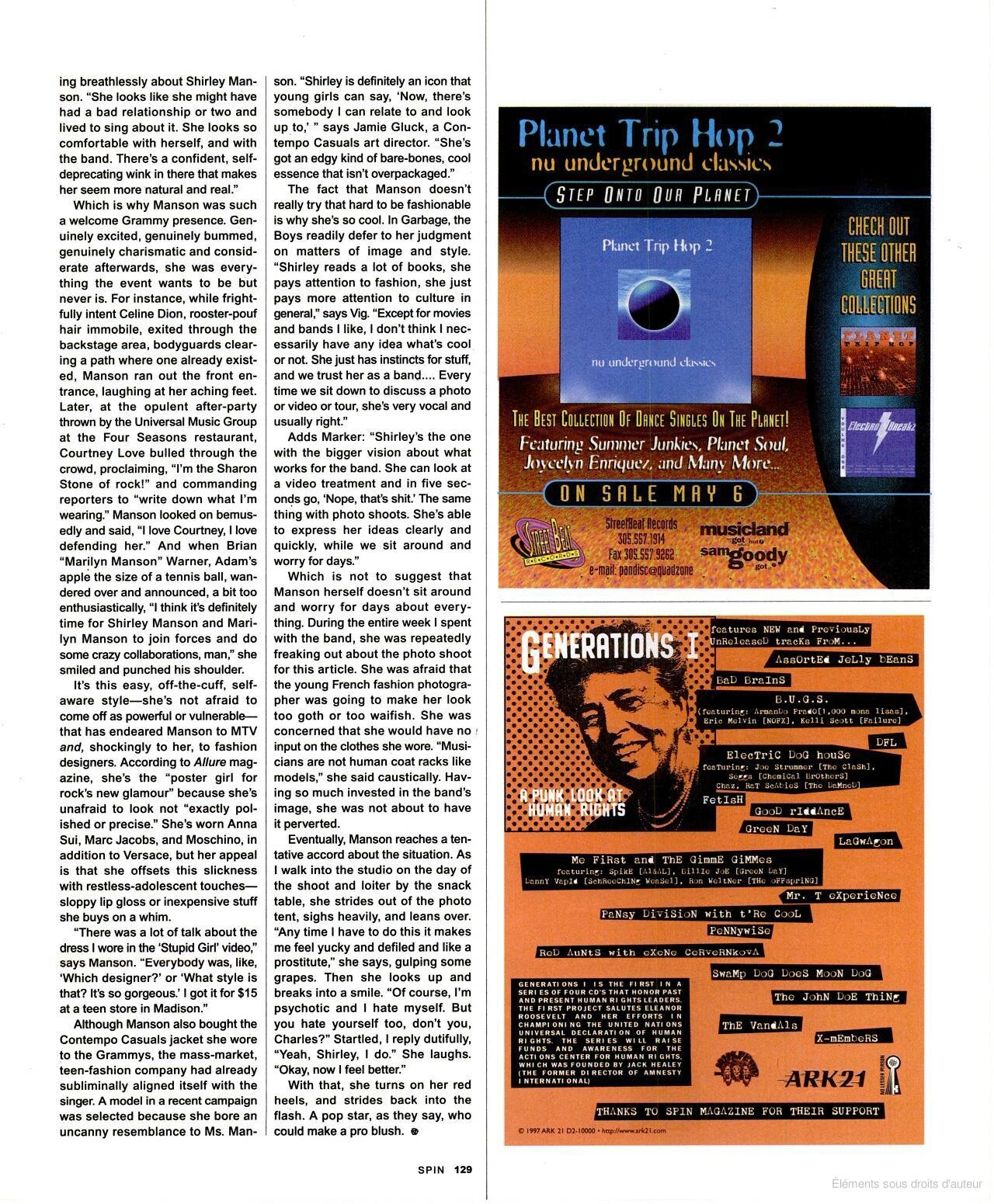
Spin 1997, June

garbage-mag-spin-1997-06-cover  Spin
pays magazine: Etats-Unis
date juin 1997
Couverture "Talking trash with Shirley Manson" et article de 8 pages.
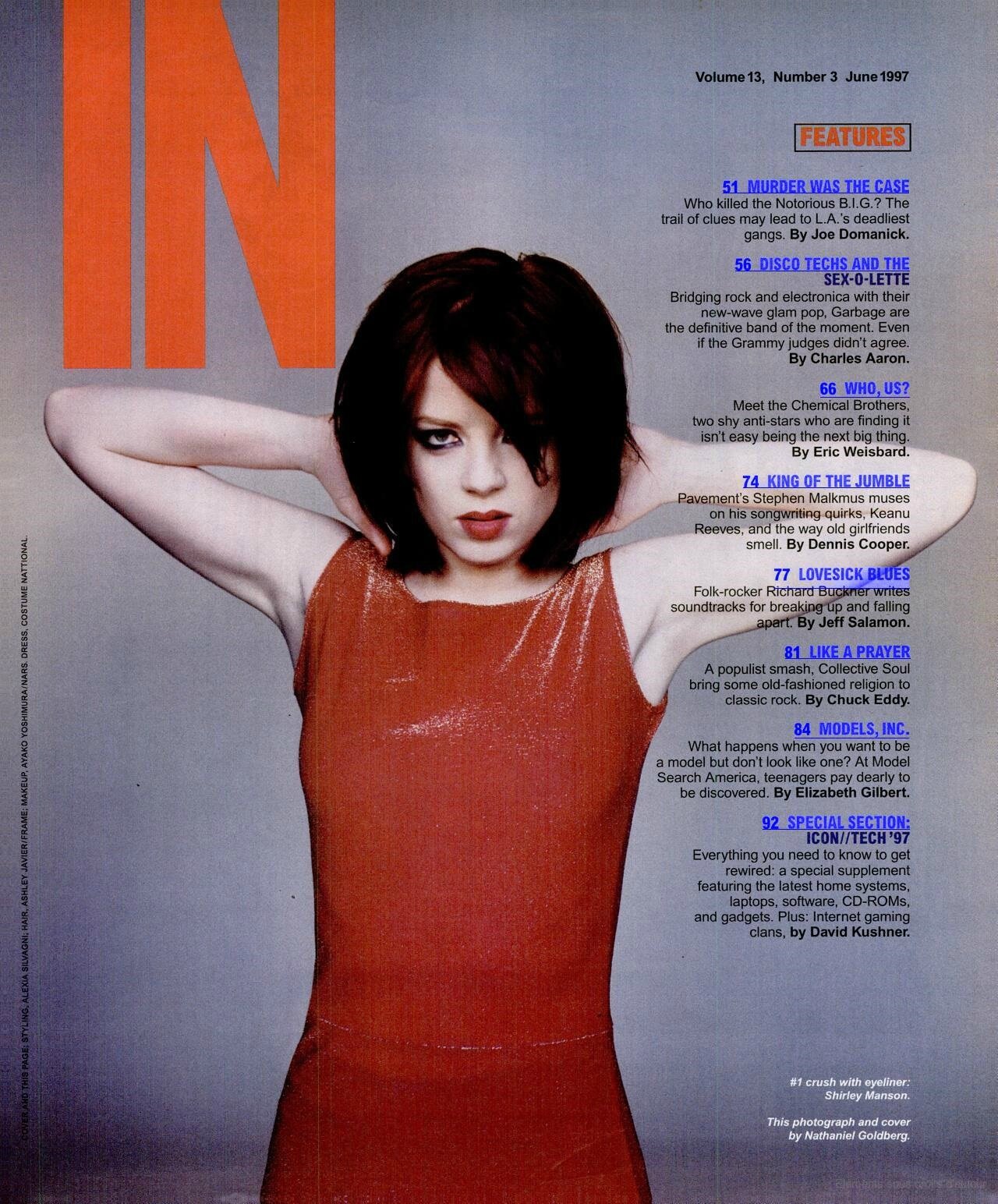
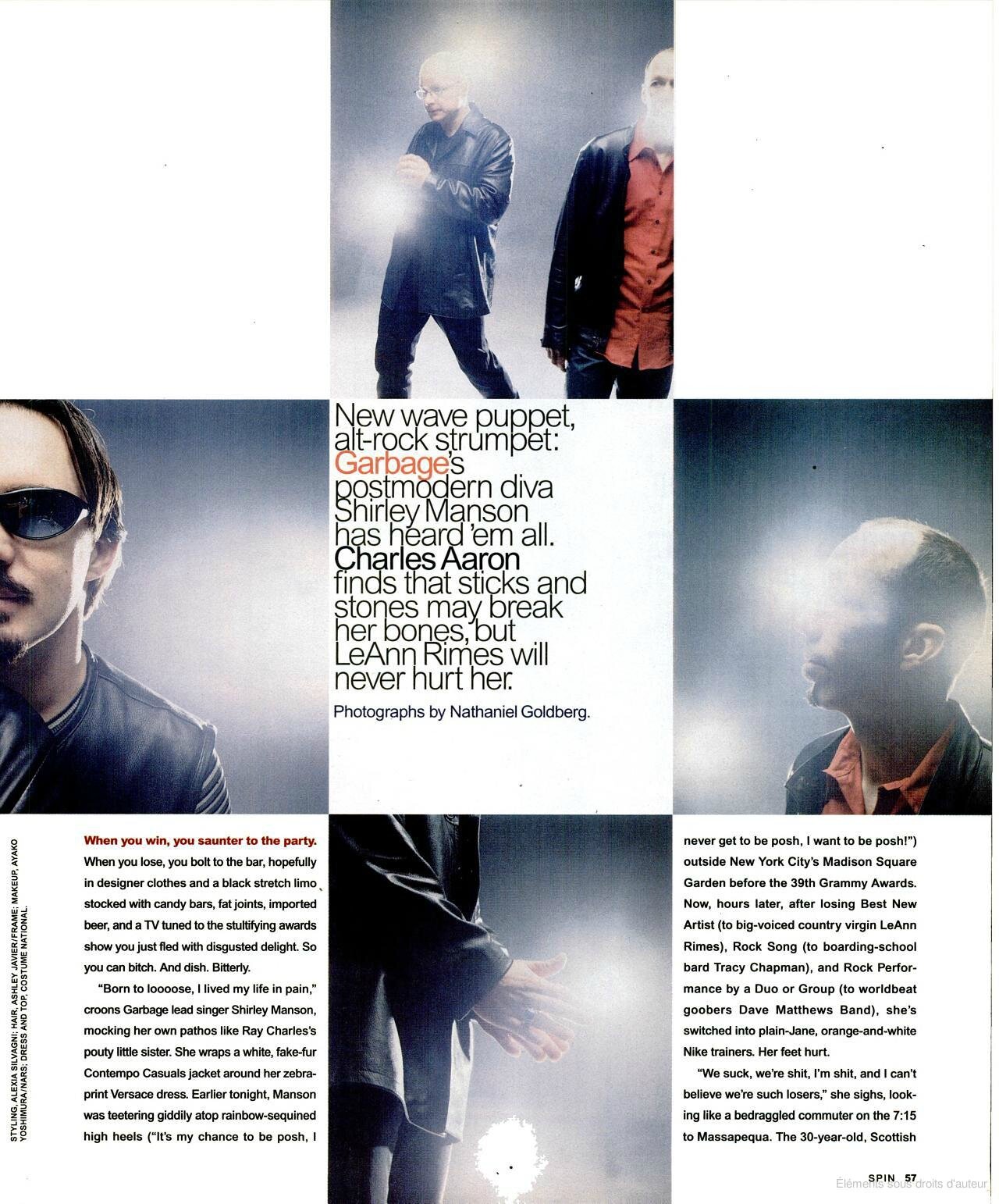
Styling: Alexia Silvagni; Hair: Ashley Javier / Frame; Makeup: Ayako Yoshimura / Nars; Dress and Top: Costume National.
Photographs by Nathaniel Goldberg.

> sommaire
garbage-mag-spin-1997-06-sommaire 

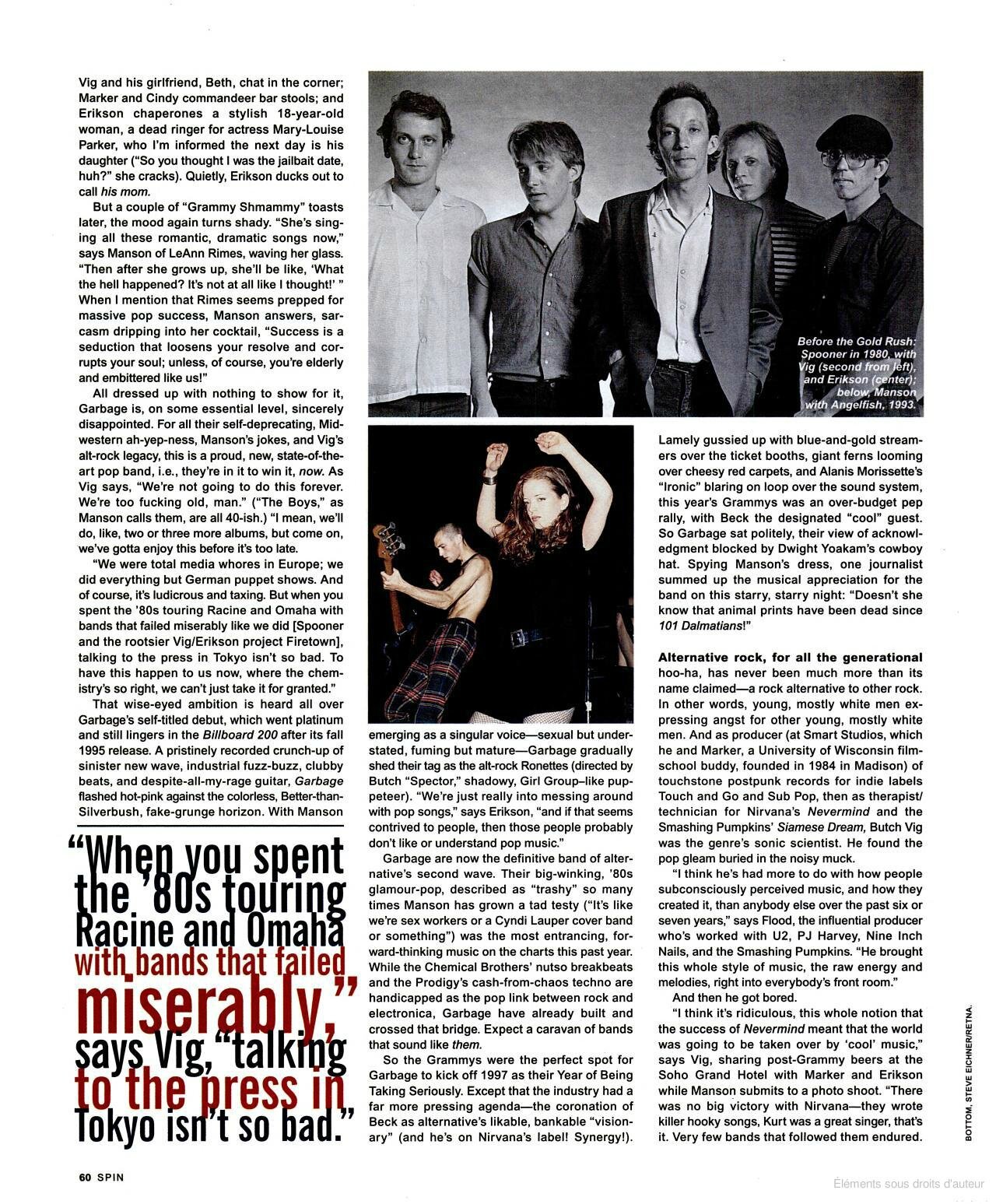
> article
garbage-mag-spin-1997-06-p56 garbage-mag-spin-1997-06-p57 
garbage-mag-spin-1997-06-p58 garbage-mag-spin-1997-06-p60 
garbage-mag-spin-1997-06-p62 garbage-mag-spin-1997-06-p64a
garbage-mag-spin-1997-06-p128 garbage-mag-spin-1997-06-p129 

Enregistrer

Enregistrer

28 mai 2016

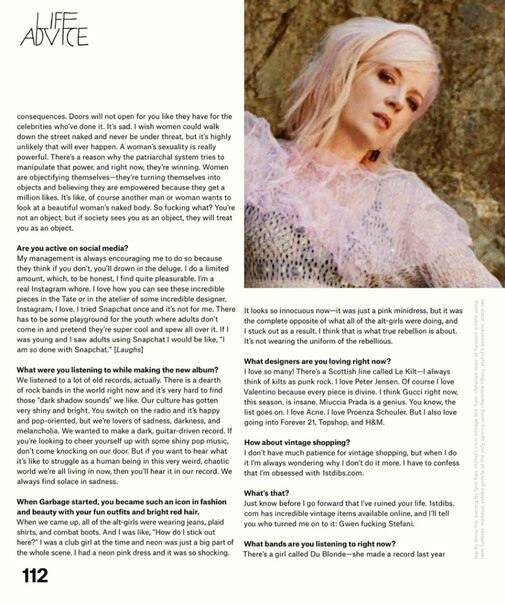
Magazine Nylon Juin/Juillet 2016

nylon-2016-cover Nylon
édition juin/juillet 2016
pays magazine: USA

article de 6 pages sur Shirley Manson: "Gleaning Gold from the Alt-Rock Goddess".

--Bonus Info-- Séance photo:
Lieu: Bronson Canyon, un petit canyon situé à Griffith Park, Los Angeles.

Photographies de Felisha Tolentino
Stylisme: Marjan Malakpour
Maquillage: Christian Marc

nylon-mag-1 nylon-mag-109 
nylon-mag-110 nylon-mag-111 
nylon-mag-112 nylon-mag-113  


Alt-Rock Goddess Shirley Manson Gave Us Her Pearls of Wisdom
Just in time for Garbage’s sixth album release

( source article en ligne sur nylon.com )
By Jade Taylor

2016-05-NYLON_sitting-2016-06-shirley_by_Felisha_Tolentino-2-1a 
Photographed by Felisha Tolentino. Styled by Marjan Malakpour.  

The following feature appears in the June/July issue of NYLON.

I’m riding through Los Angeles with Garbage frontwoman Shirley Manson, heading north toward Griffith Park for her photo shoot—a location Manson handpicked—specifically, the caves featured in the old Batman TV series. She’s wearing a white lace Valentino dress and patent leather white boots, a look that complements her faded pastel pink hair. We park the car and she heads to the opening of the cave, posing for the photographer like a white witch plucked from a dystopian fairy tale. Rocks begin to cascade off the cliff and tumble toward her, to which Manson shouts, “She died for rock ’n’ roll!”

Before I have time to process the magnitude of this moment—sharing space with the woman who basically soundtracked my pre-tween existence, from the Garbage songs featured on Daria, The X-Files, and Goosebumps to a decade of playing Version 2.0 on repeat—I’m sitting next to Manson on a couch inside her L.A. home. Books are stacked from floor to ceiling, bundles of sage rest comfortably on her coffee table. I’m hypnotized by Manson’s brilliant takes on everything from contemporary feminism to the inspiration behind Strange Little Birds, Garbage’s excellent sixth studio album, out June 10 on Stunvolume, the band’s own label. Perhaps the thing I’m most unprepared for is Manson’s laugh. It’s loud and infectious and follows almost every sentence she utters, serving as a sweet buffer between each pearl of heavy, honest, hard-earned wisdom. She’s well aware of her own strength, intelligence, weirdness, darkness, and humor, but she’s also aware that she hasn’t always been this way. And she knows that that’s okay, too.

nylon-shirley_manson_2 
Photographed by Felisha Tolentino. Styled by Marjan Malakpour. 

What inspired you to start playing music?
I played the violin at age eight and piano shortly thereafter, and I studied clarinet in high school and sang in the school choir. My mother was a big band singer, and my sisters and I listened to musical theater—The Sound of Music, Cabaret, Oklahoma, things like that. After discovering my mom’s record collection I began listening to Billie Holiday, Nina Simone, and Sarah Vaughan. And then the hormones hit, and I was hanging out with some older boys who introduced me to the Clash, Adam and the Ants, and Siouxsie and the Banshees. That’s when the idea of rebellious music really kicked in for me.

Garbage just celebrated its 20th anniversary. Does that seem crazy to you?
I didn’t think we would ever get to this point. This last year has almost been like the beginning of the band for me because I realize how fucking lucky we are. I’m among a handful of women who have been able to enjoy a career in alternative rock music. I played in two bands before joining Garbage and I remember thinking if I could just have one single on the radio that would be amazing. If I could just have a career like Echo and the Bunnymen that would be even more amazing. To sit back and look at the career that we’ve had is fucking surreal.  

Was it hard for you being the only girl in the band?
It’s difficult sometimes to distinguish what is just a normal difficulty as a musician, because, make no mistake, to be a musician is challenging for a lot of reasons, not least of which because it’s competitive. You go up against the wall all day long, and it’s tough for everyone, men and women. But unfortunately there is an incredibly sexist patriarchal system in place in the industry. I’ve never really felt discriminated against by another musician, but I definitely have within the business, which has been difficult to stomach but not so difficult to counter. If you recognize it for what it is, you can fight it.

In light of Kesha’s recent lawsuit and the allegations against music publicist Heathcliff Berru, it seems as though women are speaking out more now, thanks in part to social media.
It’s a different climate now. The glorious thing that my peers and I enjoyed was that for a brief moment, alternative music ruled the roost. If you weren’t alternative, you weren’t getting played on radio. You weren’t getting on the front cover of magazines. It was us bitches who were. And women were taking the game to their male counterparts and expecting to be treated as equals. It was a different time, and that’s apparent when you look at all of these summer festivals—where are all the women on the bill? And it’s not because women aren’t making music. It’s not because there aren’t great bands out there. It’s because they are not being given the opportunity. In the ’90s, if anyone asked female musicians if we were feminists, we’d be like, “Yeah, we’re fucking feminists!” We all had different styles, but we were all very vocal and we pushed.

Was your generation’s feminism more aggressive?
There is a problem in equating feminism with aggression, and I think a lot of young girls as a result wanted to distance themselves from being mistaken for being man-hating women. The most important message we can impart is that feminism is about equality—nothing more and nothing less. It has nothing to do with how you interact with other women. It has nothing to do with how you interact with men. All it means is that you believe in the idea of equality between men and women. I really hope that young women understand that. It’s important for all of us to stand together and galvanize and demand equality, because without that, we’re never going to secure it.

What can young girls do now?
They should believe that they are as worthy as anybody else—they’re as smart, brilliant, creative, resourceful, and they have everything they need. I think a lot of women grow up feeling like they don’t have what they need to flourish. They’re scared to fail. And yes, you will fail. So what? You stand back up and fail again and keep trying until you get the job or the life you need. Failure is a part of life, and without it you’ll never succeed. You build your arsenal by experience, by standing back up to take another hit. I wish I had known that more in my own life. Instead, I just sat there looking at everybody else—she’s this, she’s that, she comes from money, she’s beautiful, she’s a great athlete. Eventually I did make whatever small gifts I have work for me, but I think most women feel that they are not good enough, and my point is you are. Just fucking go work it.

What advice do you have for young female musicians?
I’m wary of giving advice to other musicians because the choices I make might be right for me but aren’t necessarily right for everybody—but ultimately I believe that you have to be prepared to stand by your guns and be your messy, flawed, fucked-up authentic self. It’s taken me 20 years to figure out that the best version of myself is just me. It sounds incredibly simplistic, but it’s not. I would also tell them to have something to say. Don’t just stand up there and look pretty. It’s not enough. The media will tell you that it’s enough, but being pretty means fuck all long-term. You have to be prepared to work hard, sacrifice, be competitive, and be ambitious. There are millions of people wanting to do what we do, and somehow you have to find a way to stand out. The best way to do that is to be your authentic self, because that’s what makes you unique.  

Who do you think is doing a good job of that right now?
The one who comes right to mind is Grimes. She, to me, is the greatest example of a new generation doing something that none of my peers did. I look at her and really believe that she’s a bona fide original. She writes and produces all of her own material. She’s a force to be reckoned with. She’s not just standing up there looking cute, or knowing the right people. There’s a lot of that right now, particularly on social media. There’s a lot of posturing and “Look at my cool lifestyle!” and “Look how beautiful I am” and “Look how outrageous I am!” And that’s all very well and good, honey, but where’s your music? Produce something. Do the work.

Do you think social media is a blessing or a curse?
Social media has put a pressure on women that my generation did not have to endure. So much is made of your appearance, of your popularity, and I feel really passionate about being a voice out there that is the opposite of what we’re being told by the media—that taking our clothes off on social media is empowering. By no means is that an empowering act. Now I’m not saying that you cannot enjoy your naked body—you absolutely should! And if you want to put yourself on social media in the nude, so be it. But be aware that there will be consequences. Doors will not open for you like they have for the celebrities who’ve done it. It’s sad. I wish women could walk down the street naked and never be under threat, but it’s highly unlikely that will ever happen. A woman’s sexuality is really powerful. There’s a reason why the patriarchal system tries to manipulate that power, and right now, they’re winning. Women are objectifying themselves—they’re turning themselves into objects and believing they are empowered because they get a million likes. It’s like, of course another man or woman wants to look at a beautiful woman’s naked body. So fucking what? You’re not an object, but if society sees you as an object, they will treat you as an object.

Are you active on social media?
My management is always encouraging me to do so because they think if you don’t, you’ll drown in the deluge. I do a limited amount, which, to be honest, I find quite pleasurable. I’m a real Instagram whore. I love how you can see these incredible pieces in the Tate or in the atelier of some incredible designer. Instagram, I love. I tried Snapchat once and it’s not for me. There has to be some playground for the youth where adults don’t come in and pretend they’re super cool and spew all over it. If I was young and I saw adults using Snapchat I would be like, “I am so done with Snapchat.” [Laughs]

What were you listening to while making the new album?
We listened to a lot of old records, actually. There is a dearth of rock bands in the world right now and it’s very hard to find those “dark shadow sounds” we like. Our culture has gotten very shiny and bright. You switch on the radio and it’s happy and pop-oriented, but we’re lovers of sadness, darkness, and melancholia. We wanted to make a dark, guitar-driven record. If you’re looking to cheer yourself up with some shiny pop music, don’t come knocking on our door. But if you want to hear what it’s like to struggle as a human being in this very weird, chaotic world we’re all living in now, then you’ll hear it in our record. We always find solace in sadness.


--Bonus Photos--

2016-05-NYLON_sitting-2016-06-shirley_by_Felisha_Tolentino-2-3 
  2016-05-NYLON_sitting-2016-06-shirley_by_Felisha_Tolentino-2-2  2016-05-NYLON_sitting-2016-06-shirley_by_Felisha_Tolentino-3-1 

> Coulisse de la séance
-Shirley et la photographe Felisha Tolentino-
2016-05-NYLON_sitting-2016-06-shirley_by_Felisha_Tolentino-1-set-with_felisha-1 
-Shirley et le maquilleur Christian Marc-
nylon-mag-set  

Enregistrer

16 décembre 2016

Isthmus, September, 21, 2001

 garbage-mag-2001-09-21-isthmus-usa  Isthmus
The Weekly Newspaper of Madison

pays magazine: USA
date September, 21, 2001


> article on isthmus.com
Garbage: Can the Madison band's new sound succeed in the fickle pop marketplace?
by Tom Laskin

garbage092101-042912 

Garbage emerge with a new sound, but can they match their old success ?

Garbage have a problem on the eve of the Oct. 2 release of their third CD, Beautifulgarbage. A really big one.

Back in the mid-'90s, when the Madison-based band first made their mark on the international pop scene, buoyant, angst-filled tunes like "Queer" and "I'm Only Happy When It Rains" fit easily into a commercial music world chock-full of alternative rock and pop acts. These were halcyon days for the new, mildly subversive bands that followed in the wake of Nirvana's paradigm-shifting Nevermind, a recording that also transformed the musical life of its producer, Garbage member and Madison resident Butch Vig.

But today, everything's changed in the music industry. Companies have cut back on the number of discs they release each year; CD sales are declining in this country and elsewhere; top-selling bands that Garbage once shared stages with (e.g., Smashing Pumpkins) no longer exist. More important, the much-ballyhooed rock revival currently taking control of the sales charts in the United States favors Godsmack, Slipknot, Limp Bizkit and other aggressive, ultra-masculine "mud" metal acts whose roots extend to '80s hair bands, gangsta rap and hardcore punk.

Garbage, on the other hand, is led by changeable Scottish singer Shirley Manson, who's in the habit of layering moody self-deprecation over the band's mix of European-influenced electronic beats and '60s-inspired song structures. Frankly, both the singer and the songs will strike some teenage and preteen listeners as coming from another pop age.

And Garbage's membership realizes as much. As drummer Vig puts it: "I don't think we feel hemmed in creatively by pop or 'mud,' but it's definitely a weird time in music. We're on our third record, and we feel very lucky about that. Everything's so singles-oriented and hit-oriented now that most bands really don't have a 'career' anymore. The whole manufactured bubblegum thing with Britney Spears and O Town and the Backstreet Boys -- that's what it's all about now."

Vig points out that Garbage have never had a hit single in this country. "We've had songs in the past that have been minor radio hits or on MTV, but they haven't, you know, been massive," he says, stroking his black, Dutch Master-style Vandyke beard during an interview on Smart Studios' small second-story deck. "Really, we're lucky that we've done well enough to continue doing this. But we just made this record, and we hope people buy it."

Like Vig, Garbage's fiftysomething guitarist and keyboardist, the lanky Duke Erikson, flirted with big-time success in the local bands Spooner and Fire Town before scoring with Garbage. "Where do we fit in right now?" Erikson asks. "We probably don't fit anywhere. That's really been true all along during our career. In the past it was a bit more clear where we would land, but we never had the feeling that we belonged to any of the genres, say, on the radio. Sure, we've heard from the record company that what we're doing is over or whatever, but I don't know, we've always tried to make a niche for ourselves."

In the past, finding that niche on the radio and in the CD racks led to both popular and financial success. After spending time in the aftermath of Nevermind's success recording and remixing everyone from Smashing Pumpkins to Nine Inch Nails, Vig was ready to use his modest Madison recording facility, Smart Studios, for a personal musical project. Smart co-owner Steve Marker, a longtime musical associate and friend, and Erikson had the same inclination. But unlike many of their peers in the Madison music scene, they weren't especially interested in following the normal route of playing clubs and hoping for label interest. Instead, they cast about for a female singer to front the band, eventually hitting on Scotland's Shirley Manson, whom Marker had caught on MTV singing in a video by her old band Angelfish. When "Queer," the fledgling band's contribution to a small English CD magazine, began to receive regular U.K. airplay in 1994, they quickly secured a prominent place in the burgeoning alternative rock marketplace.

Both Garbage's self-titled debut album and the more electronic Version 2.0 were commercial successes, confirming that the band was not simply the flavor of the month. Each has sold 4 million copies worldwide, and Garbage have endured as other onetime alt-rock stars have faded into musical memory. Whether they can maintain those numbers in an industry that cares about little else depends on the quality of the material on Beautifulgarbage.

Future success, however, also depends on making new inroads in the American music market. With the first album, there was a 50-50 split between sales in the U.S. and the rest of the world, says Vig, and that was to be expected, given the way European audiences first warmed to the band. Version 2.0 didn't do nearly as well in the U.S., with the sales split running 60-40 in favor of purchases abroad. When it comes to commercial pop acts, the theory is that while the rest of the world is important, longevity and popularity are determined by U.S. audiences.

At the end of the day, Garbage, like any other major- or indie-label band, really have limited control over how their music does at the cash register. Erikson and Vig both understand as much, and are taking a wait-and-see attitude until the new album is out for a few months. Much to their delight, what they can count on these days is being received by the press as a "real" band after many years of being dealt with as a kind of artificial studio creation.

"We just did a three-week press trip in Europe, and this is the first time that people didn't ask me, like on the first record, about Kurt Cobain," Vig explains with a smile. "Or about what it was like to be in the background behind Shirley, or if we were a real band, which they asked all the time on the second record. This is the first time that they just asked about the music, and that was refreshing. Vig says a certain cynicism greeted Garbage's first two records. "We felt that a lot of journalists didn't think we were the real deal," he says. "That we were this weird studio concoction. But we knew we were a band. We lived together and worked together and wrote and produced together and were friends. But I think after playing 270 concerts and all the attendant interviews and other press stuff, people don't care about those questions about the band anymore. Now they're just open and curious about what kind of music we made."

That new music doesn't represent a radical break from either their debut or Version 2.0. On the other hand, the considerable sonic tweaking and abundant sampling that characterized the latter CD have been removed from Garbage's palette. Bass, drum and guitar configurations support songs that in the past would have been gussied up with a wealth of keyboards and other multitracked instruments. And Manson, who some critics have felt came across as mechanical and disengaged on past efforts, exposes her core emotions with singular intent on two bittersweet reflections on failed relationships, the wistful "Cup of Cup" and the crepuscular lover's lament "Drive You Home."

Would-be radio tracks like the bombastic guitar anthem "Shut Your Mouth" and the broad, Phil Spector-style salute to '50s girl groups "Can't Cry These Tears" glisten with a familiar studio sheen, but they don't really represent the overall feel or musical direction of Beautifulgarbage. In fact, if there is a musical theme running through the album, it's the band's abandonment of digitally manipulated perfection in favor of rawer guitars and more immediate vocal performances.

It's no accident that Garbage sounds more like bands that come together in a practice space and then slug it out on a van tour for months at a time. Both Erikson and Vig say that Garbage wanted to reflect the chemistry they established from playing hundreds of concerts and spending days together on cramped tour buses.

"It's a much simpler record than Version 2.0," Vig says. "All of the songs sort of came from us playing live downstairs [in Smart Studios] with guitar, bass and drums. Duke might be playing piano or keyboards too. That was the only conscious decision we made -- to make the songs simpler. Some of the songs are still layered in spots; compared to the last record, there're about half as many tracks. As far as sounds go, it's basically drums, bass, some heavy guitars and Shirley singing. There aren't 10 extra drum tracks or 10 extra guitars panning back and forth between channels."

Erikson concurs that the move toward a live band sound and relative simplicity in terms of production are clearly reflected in the final mix of the album. "A lot of songs took shape in just a few hours as opposed to a few months with the last record," he says. "Some of the songs obviously took a long time, or we wouldn't have been in the studio for a full year. But a lot of them happened very quickly. 'Silence Is Golden' we recorded basically in three days and it was done. 'So Like a Rose,' for the most part, was recorded in three hours. I think we spent a lot of time just trying to resist adding stuff to [the new album]. Because that was our tendency on the other two records."

Erikson admits that Garbage has had a hard time knowing when to stop in the studio, laughing at the band's previous obsession with sonic detail. "Whether it's painting or writing or recording music, knowing when to stop is half of art," he says. "We just kept right on a-goin" on the first two records. We were trying to make these big soundscapes, a Jackson Pollock painting rather than a Rothko."

In terms of lyrics, all of which are written by Manson, Erikson and Vig feel that working fast helped bring an immediacy to the new album as well. The relationship tunes really do sound as if they came in a flash of inspiration to Manson as she jammed with the "boys" at Smart Studios. But a pair of tracks, the in-your-face rock-pop construction "Shut Your Mouth" and the genuinely angry "Parade," radiate a more deliberate tone and message. Lines like "We know your music but of course we'd never buy it" from "Shut Your Mouth" and "Oh let's bomb the factory/That makes all the wannabes" from "Parade" seem to hit directly at the music fans and a music industry that can either make or break commercial acts like Garbage. That's a change, too, given Manson's past affection for expressing a generalized discontent with herself and the world around her.

Since Manson wasn't made available for interviews, it's hard to determine how much contempt she now feels for the trend-generating machine that helped make Garbage a success. And neither Vig nor Erikson is so impolitic as to offer a pointed interpretation of these very harsh songs. After a pause, however, Vig does allow that "they aren't specifically responses to the industry, but they could be read that way. Shirley has said that, for example, 'Shut Your Mouth' is about all the bullshit that's out there, but it's also a sort of note to self to keep your mouth shut, because she says she's the biggest, most opinionated loudmouth of anyone around. So they work on multiple levels."

Does that mean Garbage are merely playing with anti-industry and anti-mass-culture rhetoric? Any real animosity would be understandable in light of a protracted legal battle with the Universal Music Group, which absorbed the band's original American label, Almo Sounds, and then attempted to transfer Garbage's contract to the Interscope label without any input from the band. That legal fight, says Vig, is currently in limbo, and in fact, the new CD bears both the Almo and Interscope imprints. For now the band and its corporate bosses both seem content to shift into promotion and touring mode and leave the bickering to the lawyers.

Even if Garbage can't be pinned down when it comes to critiquing their personal relationship with the industry, one thing's for sure: On some levels Beautifulgarbage is far less commercially accommodating than any of the band's previous work. It embraces no particular sound or style. It comes across with ideas and commentary that challenge rather than coerce, and the playing lacks the burnished, artificial quality that's characteristic of so much youth-oriented music these days.

Whether any of these changes attract the attention of the wider music-buying public is the big question mark. Garbage say they'll know more when the album is released in October and when they mount a major world tour sometime this winter. Right now, they're just another veteran rock band trying to fit into a rapidly changing music industry.

Enregistrer

Enregistrer

31 mai 2025

Rock & Folk, juin 2025

Rock & Folk
n°694
Juin 2025

.
pays: France
paru le 24/05/2025
prix: 6,99 €
contient un article de 4 pages d'une interview avec Shirley Manson
+ critique de leur nouvel album "Let All That We Imagine Be The Light"
.

- article -

.
- critique -

.


© All images are copyright and protected by their respective owners, assignees or others.

4 décembre 2016

Ladygunn Fall/Winter 2016

LADYGUNN-14-ASHLEY-SMITH  LADYGUNN-14-BROOKE-CANDY 
LADYGUNN-14-LAVERNE-COX LADYGUNN-14-LION-BABE LADYGUNN-14-RAE-SREMMURD  

 Ladygunn
n°14
5 couvertures différentes
pays magazine: USA

édition hiver 2016
article sur Shirley Manson


2016-11-by_Kathryna_Hancock-ladygunn-01 

Shirley Manson
( source article ladygunn.com )
Friday, November, 25, 2016

 LADYGUNN-shirley-manson-kathryna-hancock-2   
 story /  Alyssa Hardy
photos /  Kathryna Hancock
styling /  Candice Lambert
makeup /  Jeffrey Baum
hair /  Nikki Providence

In an era where ‘90s nostalgia has reached new heights, the true culture of the decade often gets lost in a sea of flannels, chokers and “What Kids These Days Don’t Get” listicles. Of course, a resurgence is natural as fashion trends cycle  around and the aging youth begins to long for their past, but the Internet has transformed a decade full of culture-shifting discoveries into something you can purchase online. Enter Shirley Manson: the iconic singer of infamous ‘90s grunge rock group, Garbage. Now 50 years old, the pink-haired frontwoman has reemerged with a new album in tow, one which reintroduces the true spirit of the time.

“I do think there is a lot of love for the generation—my generation—who emerged in the ‘90s at a time when the alternative culture was really dominating the extreme culture,” she tells me over the phone, a hint of amusement in her voice.

As Garbage sets out on tour with their record, Strange Little Birds, they’ve realized that their fan-base, present company included, has not only remained loyal, but has grown. “We enjoyed a No. 1 rock record with this album, and that literally feels like a miracle. Particularly for a woman of my age—and I could count on my digits how many women have been able to do that—it’s really unusual,” Manson shares. “It’s very difficult to hold onto an audience these days because there’s always something new to listen to, there’s always someone new to fall in love with.”

As she looked out into the faces of the crowds who attended her west coast tour this past year, the singer saw something she didn’t expect: young people.

“I think that’s one of the things that has struck us the most on this tour is, all of a sudden, there’s a whole new generation of very young women competing at the front of the gates. You don’t want to be stuck in your own world. You always want to be stretching a hand out across a dark sea and hope that you can connect with a new ear, a fresh ear, of people who put perspective to the field across generations and, again, that’s really powerful and inspiring,” she shares.

As you can tell from her particular penchant toward the women in her audience, Manson is famously feminist in an unapologetic, no-holds-barred way. Recently, she made a shocking revelation to Billboard about her experience with sexual assault at age 14, something which has certainly framed the way she looks at our patriarchal society.

Her new fan-base has given her a renewed responsibility towards speaking her mind about it: “As I have gotten older and older, I’ve become more and more passionate about women and their role in our culture. I realize how we have allowed ourselves to be disempowered and disengaged. And I have also noticed, as I’ve gotten older myself, so many of my peers give up because they’re no longer seen as a sex symbol or a sex object.”

LADYGUNN-shirley-manson-kathryna-hancock-4 
Dress, Shushu/Tong. Jewelry, Charles Albert and J.Southern.

Since the beginning of her career, Manson has fought against the idea that sexuality is a commodity, especially when it overshadows talent. It’s a theme that has come through her music and her performances since 1995. She explains, “I think a lot of people just want to be famous, or they want to entertain, but I think there is a real opportunity for musicians who are interested in being [a part of the] counterculture. My focus is usually on young women artists because that’s who I’m invested in, but I think it goes for male artists too.”

She advises women in entertainment to be themselves and not succumb to the pressures of the pop world. “If you continue to play the traditional game, you’ll drown,” Manson muses. “Every woman seems to be interested in only being perceived as pretty, or only being perceived as popular, and until women reject that notion, they’ll continue to be part of a lineage of women who only get five minutes of fame.”

As a 20-something woman that only knows the ‘90s through watching my older sister over-tweeze her eyebrows, the underexposed time before the Internet and selfies is lost on me. I can’t help but think that not caring about “being pretty” is a great concept, but unbelievably difficult in practice. I also can’t imagine what someone in the spotlight must feel, particularly as they grow older.

“I didn’t say it was easy,” she tells me. “It’s painful and it’s depressing and you feel rejected, and dejected. Interestingly enough, a lot of people on our social media platform who criticize my appearance are mostly women. 99.9 percent of any negative criticism I endure comes from other women.”

Whether it’s feminism, music or culture, Manson’s perspective is one of an outsider. While our conversation occurs prior to Kim Kardashian’s now-infamous Paris robbery, Manson brings up something surprisingly relevant about pop culture, glamorization and the responsibility that many people struggle with, just as our collective news-feeds flood with information on the unfortunate incident.

“I really am at odd with popular culture for the most part,” the artist claims. “When I see people on social media boasting about their fur coat, or their fast cars, or all the money they have in the bank, I genuinely feel repulsed. I have traveled to India and I see children living on top of garbage, with no parents around and they’re working at the age of four years old. I understand that there are women in the Middle East that are forced to stay inside during the daylight hours so that they are not considered indecent, and I know that there are young women in Africa that are forced to endure genital mutilation. I know there are so many people who are so unlucky in this life.”

Thus, Manson’s return couldn’t have come at a better moment. We are living in a time that is so inundated with escapism that it seems like we’ve lost touch with reality. Even celebrities who are “totally themselves” often have an air of being contrived. Garbage’s frontwoman, however, has remained steadfast in her convictions.

“I was viewed as a sex symbol and I fought against it, I didn’t take my clothes off,” she recalls of her early days in the business. “I was asked to pose for Playboy and Penthouse and I rejected it, and I rejected the money involved that I had been offered. I just refused to allow myself, through my own vanity, to be lured into a cage. Because a woman’s sexuality is the most important power in the entire universe.” Arguably, posing for a sexy magazine shoot or taking your clothes off can be seen as powerful for many women, but Manson’s point is valid and personal. In fact, speaking up against the pressures of society without being prompted by a slew of online comments is almost revolutionary.

For fans of Garbage, old and new, both Manson and her band’s most recent record are refreshing additions to the current state of music.

“When I was younger, I just really wanted to make a noise show,” the singer tells me. “But as I have gotten older and I realized I have the ability to make people feel better, once I sort of figured that out, it’s become a great pleasure and joy to get up onstage and really work at putting joy onto other people’s faces, and when I see that happen, that fills me up in ways that I have been unable to fill myself up with any other sort of walk of life.”

As a whole, Manson’s return to the stage is a power move for women, for rock n’ roll, and for an ageist society. She wants to make people uncomfortable and give them an alternative way of thinking, the same way she did in the decade that gave her a voice. With this attitude, she has found her true strength.

“I think my power comes from striving to be a good artist, a truthful artist,” she says. “I’ve never been one who wants to be told I look pretty. I want to look powerful.”

LADYGUNN-shirley-manson-kathryna-hancock-3  LADYGUNN-shirley-manson-kathryna-hancock-5 
Dress, Fendi. Tights, Wolford. Jewelry, Charles Albert. Shoes, Alejandra G.

LADYGUNN-shirley-manson-kathryna-hancock-6  LADYGUNN-shirley-manson-kathryna-hancock-7  
Dress, T.N.Y.R. /Wasteland. Slip, Daniel Silverstain .
Harness, Manokhi Leatherwear.
Jewelry, Charles Albert. Boots, Public Desire.

 LADYGUNN-shirley-manson-kathryna-hancock-8 
Shirt, Daniel Silverstain. Lace sleeves, Darkest Star.
Earrings, Charles Albert.
Skirt, Frame via Wasteland.

LADYGUNN-shirley-manson-kathryna-hancock 
Dress, Fendi. Tights, Wolford.
Boots, Public Desire.
Jewelry, Charles Albert.
Choker, Topshop.

Enregistrer

8 août 2016

Garbage : « Vieillir est un soulagement »

leprogres_logo   Garbage : «Vieillir est un soulagement»
Le 03/06/2016  - en ligne sur leprogres.fr

Leur album, Strange Little Birds, ne sortira que la semaine prochaine. Mais Garbage est déjà là : sur la scène du Radiant-Bellevue ce vendredi.

le_progres-garbage-ce-vendredi-a-caluire-photo-archives-le-progres-1464896675 
Photo archives Le Progrès 

Avec quelles intentions avez-vous commencé l’enregistrement de votre nouvel album ?
Shirley Manson : « Nous n’avions pas vraiment d’intention. Notre guitariste, Duke Erikson, avait déjà quelques instrumentaux qui étaient absolument parfaits, et ça nous a tous stimulés. Ça nous a obligés à proposer des titres à la hauteur. C’est ce qui a défini l’humeur du disque, ce n’était pas vraiment une compétition, plutôt une émulation… »

Vous travaillez toujours ainsi ?
« Non, pas du tout. C’est très variable. Pour ce disque, on n’avait que très peu de temps, juste quelques semaines. Alors, on a foncé. Là où on passait des journées à se poser des questions, on a tranché dans le vif. Et franchement, j’ai adoré ça. »

Et vous avez votre propre label désormais. Qu’est-ce que ça change ?
« L’avantage, c’est que vous travaillez pour vous. Avant, il y avait toujours cette question en suspens : que va en penser la maison de disques ? Maintenant, on ne s’en soucie pas. C’est une petite différence, mais ça change la vie… »

De quoi parle ce nouvel album ?
« Dans l’ensemble, il parle de ce que cela signifie d’être un être humain aujourd’hui et dans ce monde. C’est donc un disque pensif et sombre… Il évoque le nombre d’erreurs que l’on peut commettre dans une vie, et comment les surpasser, comment apprendre de ces errements. Si on ne le fait pas, on se condamne à vivre dans la crainte. »

C’est quelque chose que vous avez appris avec les années ?
« Oui, je vis aux USA et ce pays n’encourage pas les femmes à vieillir, et à assumer leur âge. Et pourtant, vieillir, c’est apprendre, c’est avancer. Pour moi, c’est comme un soulagement, parce que l’on devient plus heureux. »

Même si l’on est une rock-star ?
« Bien sûr. Un musicien a la chance de pouvoir faire ce qui lui plaît, de pouvoir rencontrer qui il veut, dans les conditions qu’il choisit. On échappe à plein de situations qui rendent la vie très difficile aux autres gens. »

Pratique Garbage en concert, ce vendredi 3 juin à 20 heures, au Radiant-Bellevue, 1, rue Jean-Moulin, Caluire. Première partie : Heat Parade. Tarif : 34 €.

7 juin 2016

20/05/2016 Garbage interviewé par Eric Avery

2016-05-20-garbage_interviewed_by_ericavery-instagram-1  
© Instagram 

Le 20 mai 2016, Garbage est interviewé par Eric Avery, le bassiste qui les accompagne sur la tournée de Strange Little Birds. Le groupe parle de l'inspiration pour l'écriture du titre d'ouverture Sometimes.
In May 20th, 2016, Garbage is interviewed by Eric Avery, bassist who accompanied them on the Strange Little Birds tour. The group talks about the inspiration for writing the opening track Sometimes.

> video itunes.apple.com

2016-05-20-garbage_interviewed_by_ericavery-cap01 2016-05-20-garbage_interviewed_by_ericavery-cap02 2016-05-20-garbage_interviewed_by_ericavery-cap03 
2016-05-20-garbage_interviewed_by_ericavery-cap04 2016-05-20-garbage_interviewed_by_ericavery-cap05 2016-05-20-garbage_interviewed_by_ericavery-cap06 


© All images are copyright and protected by their respective owners, assignees or others.
copyright text by GinieLand.

Enregistrer

3 avril 2021

Garbage fait son retour

rockfolk-logo

 Garbage fait son retour avec "The Men Who Rule The World" et annonce un nouvel album
31/03/2021 - en ligne sur
Rock & Folk

Garbage-The-Men-Who-Ruled-the-world 

 Cinq ans après "Strange Little Birds", la bande de Shirley Manson sera de retour le 11 juin prochain avec un septième album studio, "No Gods No Masters" produit par son collaborateur de longue date, Billy Bush.

Un disque intrinsèquement affecté par le chiffre 7, "les sept vertus, les sept plaies et les sept pêchés capitaux", comme l'explique le groupe dans un post partagé sur ses réseaux sociaux. "C'était notre façon d'essayer de donner du sens à ce monde de fou et ce chaos assourdissant dans lequel nous nous trouvons", ajoute-t-il.

Garbage a pour l'occasion partagé The Men Who Rule The World, un nouveau morceau très influencé par les sonorités industrielles, et décrit comme "une critique de la montée de l'étroitesse d'esprit capitaliste, du racisme, du sexisme et de la misogynie à travers le monde".

Mis en images par le réalisateur et animateur Chilien Javi Miamor, le clip a été dévoilé dans la foulée. A découvrir ci-dessous :

Pré-commande de l'album en cliquant ici.

2 avril 2017

Addicted To Noise, 1995, September

Garbage Album Reviews
Critiques de l'album Garbage


Addicted To Noise
magazine en ligne: USA
date: septembre 1995
web: web.archive.org
1995-09-album01-review-addicted-logo 

Garbage Rise From The House That Grunge Built

Gil Kaufman Heads To Madison To Get the Skinny On The Band
That Could Turn Mega-Producer Butch Vig And His Pals Into Stars

by Gil Kaufman 
Madison, WI

 The House That Grunge Built is nestled quietly in-between muffler shops, adult bookstores and dry cleaners, and sits firmly in the shadow of the Capitol rotunda, the visual marker by which all direction is measured in Madison, Wisconsin. A nondescript brick building on the working class, east side of town, with a shoddy red paint job over the front half and a shakily scrawled address over the door, the windowless first floor of superstar producer Butch Vig's studio does more to suggest a chop shop than a rock shop.

Vig, who sat behind the board and produced Nirvana's breakthrough Nevermind, is also responsible for producing the Smashing Pumpkins' Gish and Siamese Dream, and a host of other stars in the alternarock universe including Urge Overkill, Gumball, L7, The Fluid, Tad, and the Poster Children. But these days, Vig has other things on his mind than producing somebody else's smash album.

Lately, Butch Vig has been thinking about garbage. Well, actually he's been thinking about Garbage, with a capital G. Garbage is the band Vig has formed with his partner in the studio (and long-time friend), Steve Marker, Duke Erikson, and a mysterious young singer from Scotland named Shirley Manson.

Butch Vig wants his own platinum record.

Already, Garbage has scored a hit single in England with the radio-friendly "Vow," released last year on a whim as a part of the Volume compilation. That song earned them an avalanche of European interest, before anyone had even heard of them stateside.

The Garbage album, released last month, is being greeted with critical praise. And for good reason. What the group has recorded, considering Vig's pedigree, is a surprisingly non-guitar rock mix of ambient noise, shifting trip-hop beats, grinding jungle rhythms and an ocean-size chunk of buzzing noise that, somehow, gels and rises above the din thanks to catchy hooks and killer song construction.

The sound of Garbage is akin to a Jackson Pollock painting, thick layers upon layers of sound that have been stripped down, torn apart, pasted together and then stripped again, until the result is a dizzying soundscape that reveals fresh nuances upon repeated listening. It's the sound of Portishead's bus smashing into Siouxsie Sioux's limousine and starting a chain-reaction accident involving everybody from Roxy Music to Echo and the Bunnymen (with Trent Reznor ending up in the hospital after falling off his scooter). Or as Vig will put it, "a killer pop album," but with a decidedly dark side.

Coincidentally, I meet up with Garbage, the band, the day before Garbage, the album, hits the streets. Also coincidentally, heaps of trash line the curbs, for tomorrow is moving day for the 35,000 students at the University of Wisconsin. The members of Garbage hope they outlast the junk man.

GET SMART

"Sorry I'm late, they're doing construction and it took me, like, an hour to get over here," Vig says as he blows into Smart Studios. He rushes to extend a pink-fingernailed hand in greeting, then makes a beeline for the phone to return some messages. While he dials, he asks Steve Marker where the rest of the troops are. Vig wants to make sure right away that this is going to be a group effort, not a trip down the memory lane of his greatest (producing) hits. And for someone who has done so much for the flannel nation, he's looking like one of the Three Musketeers today, what with a shoulder-length page boy haircut, swashbuckling goatee with unattached mustache and black jeans. No plaid or flannel in sight.

"This is only our second interview in the States for this record," says Vig. Then, with mock earnestness he adds. "I guess after tomorrow we'll know if we even need to do any more."

Before Vig can get too self-conscious, Erikson, also sporting pink nail polish and Manson, modeling a more subdued mix of deep red with gold flecks, amble into the studio. Asked what happened to his nail polish, Maker mumbles something about removing it because "pink isn't my shade."

Smart Studios, where Vig (drums, loops, noise), Marker (guitars, samples, more noise), Duke Erikson (guitars, bass, keyboards, a little more noise), and Shirley Manson (vocals, guitars), recorded Garbage, is about as unflash a rock & roll location as you could conjure, short of, say, Marker's basement, where the music for four of the twelve songs on the album were recorded. This low-key atmosphere is in tune with the lingering (moldy?) hippie-vibe that still hovers around Madison years after it was tagged with the "Berkeley of the Midwest" and "Third Coast" nicknames.

In fact, the best measure of how well the sound of Smart Studios fits in with the patchouli and pot culture of Madison, is to compare it to the guy who now owns the Loose Juice beverage cart on the campus quad. Twenty years ago, he was marching in the streets and plotting to blow up the math building to protest the Vietnam war. Now he spends his days mashing fruit and pouring smoothies for the kids. Ten years ago Vig and Marker were recording every punk band in sight, priming their talents for the flannel revolution. Today, they are half of a quartet that is hoping to usher in the new age of new pop music.

With the exception of Manson, the trio of men in Garbage have known each other for over a decade. Since the early 80's, when Vig and Erikson played together in the local band, Spooner, and Vig and Marker began producing punk bands on the cheap in a tiny space across the street from their current digs with only egg cartons on the walls and a cheap four-track recorder for equipment, the seeds for what has emerged as the Garbage sound have been taking root.

1995-09-album01-review-addicted-photo1 
"Shirley had a sort of darkness to her
that we immediately liked," Vig says of Manson

In 1993, after years of screwing around in their spare time, avoiding work, drinking beer, driving cabs, and banging around on instruments in Marker's basement discovering new sounds, Marker says the trio finally decided that they wanted to form a band. "I'm a musician first," says the mild-mannered Marker, who, with his well-kept, curly blond hair, Lennon glasses and dingy Chucks looks more like a University of Wisconsin philosophy teaching assistant than a rock guy. "We were always so busy producing before this that we never really had the time to record our own stuff."

They had already started working on their "own stuff" when Marker turned on MTV one night to watch "120 Minutes" and caught a video for "Suffocate Me" by a group called Angelfish (apparently, the video was shown only once on MTV). It was the singer, Shirley Manson, that caught Maker's attention. The three men had discussed bringing in a female vocalist, but hadn't found anyone that had the qualities they were after. "We knew we didn't want some trippy, happy girlie voice without any depth," says Vig. "Shirley had a sort of darkness to her that we immediately liked."

The fact that the four had never met and that she didn't even know who they were (yes, not even Vig), provided some real fireworks when the trio went to meet and greet Manson at an Angelfish gig at the Metro in Chicago last year. They had only spoken on the phone and were all nervous about the first meeting. Manson was growing increasingly unhappy with her position in Angelfish and had entertained thoughts of leaving them behind (since only she, not the band, was signed to a contract on the American label, Radioactive records). "We played the gig at Metro and afterwards I was wheeling Vic Chestnutt really fast down the sidewalk outside and I suddenly stopped and he went flying out of his wheelchair and to deliberately make me feel really awful, he let out this horrible wail, I thought, 'Fuck, they must think I'm so vile.' I tried not to make a really big scene about it, but I was dying a horrible death," says Manson in her punky Scottish burr.

Erikson, who has been standing behind Manson, kneading her shoulders since he walked in after finishing a cigarette, says, "Actually, we did think that was pretty vile," and then bursts into a subdued laugh, revealing a hint of the intimate, loose rapport these four have developed in less than a year together.

1995-09-album01-review-addicted-photo2  "Little did I know that Vic does that all the time," Manson continues. "After that we went to a dance club together and got drunk and stayed out until five in the morning at which point we decided we would try and work together."

Vig says the boys thought Manson was "kind of feisty." And that they "enjoyed hanging out together, which was a good sign. You hear someone's voice or see a picture, you may get a pre-conception of what they'll be like, but if you're going to work with them it's the chemistry of your personalities that's more important."

Now, instead of the awkwardness of those first few months, many of them spent arguing about lyrics that Manson said she "absolutely couldn't sing," there are quick-fire casual insults (most amusingly when Manson calls some of Vig's ideas "shite") and inside jokes. At one point, Manson and Marker burst into uncontrolled laughter, forcing Manson out of the room, much to the chagrin of Vig, who is confused and a little thrown off by the outburst. Upon her return, Manson puts Vig's mind at ease by explaining that she had caught Marker's eye and through an unspoken, dual remembrance of the pig movie, Babe, which everyone except Vig had seen the night before, she had lost control and had to excuse herself. Vig shrugs and tries to re-trace his train of thought as Manson dubs the porcine pic "a fucking brilliant human movie."

THE GIRL U WANT

Dressed all in black, from her tank top to her shoes, Manson's ivory, almost translucent skin and flaming red hair are the outward signals of an internal fire that comes through in her sometimes ferocious, sometimes deceptively sweet delivery. At once lithely feminine and delicate and also square-shouldered enough to knock your block off if she feels like being one of the guys, she sits with her feet up on a black swivel chair in the studio, her perfect eyebrows seemingly locked in a "yeah, fuck off" arch.

1995-09-album01-review-addicted-photo3 
"Now I work with men," says Manson.
"Before I was working with boys."


Manson, 26 (Vig coyly refuses to give the ages of the others, but suggests they are in their late thirties and not exactly pin-up boy material), saddled with an unfortunate surname shrouded in a darkness that's perhaps not as infamous in her native Scotland, says she was overjoyed to find three men that she could feel comfortable enough to work with in a band. Hailing from Edinburgh, Scotland, Manson, who will say only that she had a "fucking miserable" childhood, wherein she fancied herself the ugliest little girl in the world, joined her first rock band at 16 and has played in at least a half a dozen since.

At 17 she joined the band Goodbye Mr. MacKenzie as a backing vocalist and keyboard player and released a few albums that didn't go very far beyond their native land. Eventually, she joined the band Angelfish as lead singer, recording one 1994 album with them. Interestingly enough, the straighter pop of that album does hint at the sound Manson and the rest of Garbage have concocted, only it's a much more traditional album. Manson doesn't want to talk about her former band. "Angelfish was just a band from Scotland," she says curtly. "There's nothing to say, really."

At the time when Vig and the boys called her, Angelfish had just had a college hit; Manson recalls that time as a "stifling" one. She says the major difference between her situation then and now is this: "Now I work with men, before I was working with boys."

She says Angelfish was described in the Scottish press as New Wave or "Blondie-meets Patti Smith," but she disagrees, "it was just pop, and not very good at that."

She is self-effacing, and whether she believes it or not, tells me that she doesn't think she's much of a singer. "Your vocal style is dictated by your actual abilities and I'm not the world's greatest singer, so I suppose I've learned to develop some kind of..." at which point, Erikson, who is wont to finish the others' sentences, or supply the precise word they are seeking (myself included), whispers, "style." And after a pause and a wry grin, "No style is too good for you."

Vig, as he is also wont to do, breaks in and says, "We didn't know what we would do with the songs before we met Shirley. We had four or five songs that were initially pretty pretentious and lyrically very simple, maybe a little bit too literal. We didn't want Duke to sing, even though he's a good singer, because Steve and I thought it would sound too much like Spooner. But Steve and I were so uncomfortable with our vocals that we tried to bury them deep in the mix or totally distort them with effects.

According to Vig, before Manson's arrival, they had wanted to concoct a sound, "way more fucked up and experimental. More hardcore than Nine Inch Nails, more rhythmically groovy than a hip-hop record, more guitars than My Bloody Valentine. I actually wanted," he says, "to saturate the guitars ten times more than MBV and add tons of manipulated sounds that were twisted up until they became indistinguishable. But ultimately, a lot of that doesn't work when your trying to write a song and put it in a context that works. So we threw most of that shit out the window and tried to make the songs work on their own.

"Once Shirley came in," Vig continues, "and started singing them and writing lyrics, the songs went more in the direction that we think is better for a pop song, which is to be a little bit more ambiguous and let the listener make up his or her own mind what the song is about and not give it all away. On 'Queer' I had a scratch vocal where I just screamed all the way through and Shirley heard that and did the total opposite. She sang it with this total understatement, which makes it much more intense. You think that by screaming it's going to be intense, but a lot of times its just the opposite, it makes it more subversive."

1995-09-album01-review-addicted-photo4 
In spite of their chummy appearance,
Garbage sometimes runs into creative
differences in the studio.

Praise notwithstanding, Manson soon dredges up a still-sore point between herself and Vig about her original vocals on the song "Supervixen." The song, the first on the CD, is distinguished by a heart-stopping guitar riff that drives you up an aural mountain, only to stop at the very top and leave you hanging for a split second before a wave of sound comes crashing back in. Manson talks about one of the epic battles during the making of the record, where she argued for a vocal, a rappy, tossed-off bit she was particularly fond of, that made it onto the record, but is barely perceptible at the end of the song, buried under a pile of clashing sounds constructed by Vig.

Erikson, a droll, quietly intense figure who prefers to hover near the doorway and let the others do the talking, (he can't smoke near the mixing console, which, it is interesting to note, once belonged to the Osmond Family and still bears an Osmond sticker on the back) speaks sporadically, often in sarcastic bursts, jumps in to defend the amount of sound on the record. He says that even though they were interested in well-structured songs, they also wanted to amass layers of noise and sound that, while in-your-face, wouldn't get in the way of the melodies of the songs. Manson rolls her eyes at this backwards defense of Vig and sticks out her tongue at Erikson, mumbling "cunt" under her breath, vaguely in Vig's direction.

KURT STOOD HERE

"That's about where he stood," says Vig, somewhat reluctantly. We are standing in the basement of Smart Studios and Vig is pointing up at the moldy ceiling, approximating where Kurt Cobain stood when he laid down the vocals for "Polly," which appeared on Nevermind. We are underneath the main studio on the first floor because there is currently a band recording in there and Vig is not willing to interrupt them for a morbidity tour. Prior to this Vig took me on a mini-tour of the studio, which he cautioned is not nearly on the scale of other rock studios in L.A. or New York.

"This place is only 2,500 square feet or something, so you can't really get a huge drum sound here like you might in a bigger room at a bigger studio," he says, less as a cop-out than as a affirmation that this is the place to get a nice, warm, personal sound. He is understandably hesitant about the inevitable Nirvana questions, not wanting to seem like a grave dancer or an opportunist. He mimics a German journalist, giving a hint of the type of questions the rest of the band had to endure while promoting the record overseas, by saying "Zo, tell me about vorking vith Kurt Cobain?" Vig seems not so much reluctant as shyly protective.

Underneath Smart is an endless series of racks of equipment and a maze of iron shelving units crammed with reel-to-reel tapes, masters and DATs representing a mini-history of modern rock. As fans and humidifiers buzz in the background, Vig, prompted again to share a little more Nirvana lore, is slowly overcome by a detached look. He reluctantly talks about the need to keep moving. "I'll never make a record as critically or commercially important as Nevermind," he says quietly. "But that doesn't mean I should just retire and give it up. I am proud and lucky to have been a part of making that record, it was definitely a once in a lifetime thing."
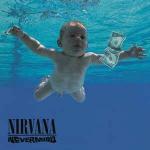
1995-09-album01-review-addicted-photo5 When pressed further about how Cobain acted, what type of person he was, how he treated Vig, he mulls it over a bit and says, "There's a sort of doctor-patient confidentiality that goes along with that relationship and when you work with somebody they bare a part of their persona to you and it's not fair to give that up."

He looks me straight in the eye, as if to say, "Get it?" Yeah, I get it. Vig seems to be saying this not just for my benefit, but maybe for his own, to again remind himself that even though those were exciting, maybe charmed times, to share them with everybody else would cheapen them and make him somewhat of a traitor.

I press on, and after a little (I think subtle) prompting, he points to another spot above us, a little to the left of the Cobain spot and motions to where Chad Smith sat, or rather stood, while Cobain tried to show him how he wanted the drums to sound. Vig gets a little bit of joy out of pantomiming Cobain's frustration at Smith's inability to get the drums to sound the right way. He then happily remembers the day when Cobain called him to tell him that he had just gotten the greatest drummer in the world, Dave Grohl. After that, Vig, without a word or a gesture, makes it clear that there will be no more Nirvana questions, and even though there are a million more, that seems okay.

THE ODD LITTLE MISTAKE

Upstairs again, Vig shows off the platinum and gold records from Nevermind Siamese Dream and three or four other albums high up on the walls in the cramped front office. He makes no apologies for the music he has helped create, least of all for Garbage. "Listen, this is a pop record. And while the three of us are too old to be pop stars­­we're no Boyz II Men, certainly not teen idols­­I think we have made a really good record. If nothing else, the name is fitting. Garbage. Here today, gone tomorrow. But, really, I hope it's more than that. I hope it's not that disposable. Of course, we have certainly left ourselves open for the ultimate one word record review, 'Garbage...Indeed.'"

The three guys in Garbage are, understandably, most comfortable talking about recording, songwriting, the making of 'records.' They've have spent much of their adult lives holed up in recording studios. "A lot of what ended up on the record," says Duke Erikson, "were sounds that we found accidentally, like Steve's sample of a tape deck backing up, or the bit in 'Stupid Girl' that was initially a mistake, but when we slowed it down, actually fit the timbre and pace of the song and became the hook."

"You can find something like that that is non-musical and by incorporating it into the song it can actually become the hook, through either repetition or dropping other things out and focusing on that somehow," says Vig.

Manson, getting up to take a phone call, adds, "I don't think we've done anything weird. There's a lot more bands doing wilder things, that's just what bands do when they get in the studio. I think we've basically just made a pop record with the odd little mistake in it that we kept."

1995-09-album01-review-addicted-photo6  The three men mull this over for a second and decide that they like that description. "The odd little mistake," repeats Erikson in a horrible approximation of Manson's accent.

The "record it today and erase it all tomorrow" attitude the group adopted helped them figure out what to do with the tracks that pre-dated Manson's arrival. "A lot of the songs, because some of the rhythm tracks were recorded before Shirley joined us, went through a series of evolutions," says Vig. "When we were working on 'As Heaven is Wide,' it started out more as a big rock track. Steve had all these guitars on it, Duke had fuzz bass, I had a live, big room drum sound on it and Shirley sang and we kind of put it away for a while. Then, one day Duke and Steve came in and erased everything and put all these techno elements on it."

Phone call completed, Manson seamlessly jumps in. "Do you remember when that was?" she asks Erikson. "That's when we heard Tom Jones on the radio and I said that's what we should do, we should make it more electronic. That's what was wrong with it, it lacked a sort of power. And taking away the really mental guitars, it made it weirder and then you two..."

Erikson, again, finishes her thought: "We started messing around with different beats and at one point Shirley comes running into the room and yells, 'That's it, do that!'"

Vig recalls that because he was out of town, he hadn't heard the track since the original mental guitar version and when he'd heard what they'd done he thought it was "supercool." "Even though Shirley had sung to this vocal rock track, her vocal was way more intense being sung over this electronic techno groove track. The only thing left from that original recording is Duke's fuzz bass and Shirley's vocal. We erased everything else. And it really worked."

Manson, again jumping in, quips, "And it's weird, because it makes the track much harder sounding by taking away the guitars. They were really loud and crunchy and we put a little inoffensive keyboards on it and it ROCKS!," she squeals in her best pseudo-American accent. "It's so weird."

Keeping up the united front, the band takes collective credit for the lyrics. They describe the words as a collaborative psycho-therapy session wherein personal demons of various sizes and importance are exorcised, vilified, taken revenge upon and laid to rest. It is, however, the slippery voice of Manson that anchors the entire affair. Her vocals, which soar, dip and crawl over the course of the CD, are executed more like mini-performances, each with barely perceptible nuances that create not just a sonic texture, but a sonic character.

Manson says that although the writing was a collaborative effort, the words obviously had to travel through her body. "Because there are two sexes in the band, there are certain things that wouldn't be appropriate maybe, or that I would want to sing about, but that the boys didn't really give a (Americanized accent) rats ass about. I'd want to sing about my periods, but I don't think the boys would be particularly interested in working all day in the studio on that kind of thing. We try to find a common ground."

Erikson looks up under a furrowed brow and says in a surprised dead-pan, "You'd love to sing about your periods?"

"If you asked us about the themes on the record, we'd probably all give you different answers," says Vig, steering the conversation in a different direction as he unconsciously twists the gold band on his ring finger. "My personal life is somewhat of a mess. There are certain lines in the songs that I relate to because they mean something to me in a way that only makes sense to me. There are things that we touch on, like voyeurism, hedonism, perversion, obsession and the art of self-destruction, these dark themes that I think a lot of people can relate to, like Shirley said, universally, in some way or another."

1995-09-album01-review-addicted-photo7 Although themes of personal strength and spirituality, in the body of angels, gods, demons and spirits, saturate the lyrics, Vig says there are quite a few songs where, "God didn't bother to show up, or maybe he showed up and it wasn't quite what you expected, or he was late."

Whether it is the tongue-in-cheek homage to Russ Meyer in "Supervixen," where Manson purrs, "We'll make a whole new religion/ A falling star that you cannot live without," or her hidden razor-in-the-mouth verse, "You thought I was a little girl/ You thought I was a little mouse/ You thought you'd take me by surprise/ Now I'm burning down your house," from "Not My Idea," the CD certainly does wallow in a seemingly, salvation-less darkness.

But Manson is quick to point out the difference between the darkness on the record and what she describes, perhaps in a dig at her old bandmates, as the self-involved angst of "hormonally-driven sixteen year-olds." She says the band is "interested in lending some depth to what we do. We hope that they are pop songs that work on one level and as you listen to them, you glean other things from either what's going on sonically or lyrically."

One of the things Garbage realized half-way through the recording process was that all their angst- and misery-bearing was turning the record into a somewhat somber, vaguely depressing affair. Enter, "Only Happy When it Rains." Set to a grinding beat and sung in a bored-to-tears deadpan by Manson, the lyrics to the song, "I'm only happy when it rains/ I feel good when things are goin' wrong/ I only listen to sad, sad songs/ Pour your misery down on me/ My only comfort is the night gone black" (you get the point), shows the lighthearted side of Garbage, even if it is hidden beneath a black-eyeliner goth veneer. "It's really just us poking fun at ourselves," says Marker. "We're poking fun at the alternarock angst, wearing your heart on your sleeve thing and at ourselves for writing such dark songs."

THE FIRST HIT

After a few hours the band members start to drift out of the room to make more preparations for tomorrow's CD release party. Vig repairs to the upstairs lounge area to do a phone interview, while Erikson removes his shirt, pops open a Sierra Nevada and plops down in a chair on the wooden deck where he says many beers were had during the recording of Garbage. Looking out over the balcony, watching a Madisonian scrape fistfuls of gunk out of his rain gutter, I'm reminded of why Vig said Madison is a great place for him, and Garbage, to make music. "I stayed here because I didn't want to get a real job," he said earlier in the day. "Plus, it's a fairly liberal town with decent restaurants. It's a nice city and because its a college town, there's plenty of good bands."

And, as he also told me earlier, he believes that Madison will continue to provide something of a reality check for him and his mates. "Ultimately, it's a small town and we're living in a fishbowl, which helps keep me grounded," he said. "I don't really see how you could be pretentious and get away with it here. If we started going around acting like pop stars, people would call us on it in a minute."

1995-09-album01-review-addicted-photo8 A half hour after heading upstairs, Vig returns, phone interview completed, and asks if I want to hear a few b-sides that they just finished for the European single of "Only Happy When It Rains." Manson also wanders back in. The songs, "Girl Don't Come," a grinding, beautiful mess of hard techno beats and "Sleep" a narcotic drone that sounds like phonetically-correct ear candy, produce a far-away look in both Vig and Manson's eyes as they concentrate hard on the music pounding out of the massive speakers, each tapping their feet to the beat.

As she munches on crackers and sips mineral water, a sliver of a smile crosses Manson's face, suggesting that, maybe, just maybe, she is actually happy with how the mix on the songs sounds. After "Sleep" fades, Vig pops the DAT out of the player and looks at Manson. "'Don't Come' needs more guitars," he says in a half-question.

"Yeah, you're right," she says, dead-pan. Then with a sneer she ads, "And the fucking vocals need to be further up."

After spending much of the day with the group, I decide it's time to ask Vig how he feels about sharing the spotlight that's been aimed at him due to the hits he's produced, with his three bandmates. He says it was never really a concern. He also says that, to some extent, he's burned out on producing indie-nation bands. "If anything, we didn't want to have to be a band that is two guitars, bass and drums, plays in the basement, then go and record yourself au natural in the studio," says Vig, not afraid to shoot himself in his gilded foot. "That kind of alternarock scene, I think, to a certain extent, is getting stale."

The bands Vig says he is excited about are ones that are making more eclectic pop records, like Tricky, Portishead, and Bjork, to name a few. The band says they hope they're a hit on the dance floor. In fact, they say they've talked to a number of re-mixers in the hope that they can find someone to come in and Garbageize the songs, i.e., erase everything except for the vocals and totally re-invent the songs.

Garbage never intended to release their first single at all. In November of last year their British manager called and said they had a chance to submit a song for Volume, a well-respected CD compilation/booklet, the only catch was that they had to have it ready within three days. They quickly finished the song "Vow," the only one they felt was close to being done. Before they knew it, British radio picked up the song. Within a few months KROQ (FM) in LA and a Modern Rock station in Seattle also picked it up.

1995-09-album01-review-addicted-photo9
"I don't really care if we become rock stars.
I just want to sell enough records so that we
can tour the world," dreams Manson.

This screwed the band up a little, because they realized that they didn't necessarily want "Vow" to be their first single, or a single at all. Not only that, but the song doesn't really best represent the Garbage sound. Like those unfortunate masses who were suckered into Beck's excellent debut thinking they would get a dozen "Loser" re-treads, anyone who picks up Garbage expecting twelve alternative guitar hits with chick vocals will be disappointed. In fact, "Vow" is surely the exception on the record, the only hint that one of the members is known more for cock rock than club hits. "Actually I've begun to think that it's quite fortunate that 'Vow' was the first single," says Manson, ever contrary. "Because had we done one of the more clubby tunes we would have been pigeonholed as a dance band and that's a hard tag to shake. Now we can do whatever and people won't know what to expect."

Manson tells me that a few nights ago at their favorite local bar, Cafe Montmarte, the owner, a friend of theirs, played a few tracks off an advance of Garbage and she was both excited and horrified. "It occurred to me that as of tomorrow, people in the States will be able to slag us off for the first time," she says. "Before this we've never sold a single record in this country. That's a bit scary."

Even as Marker laughs a little at the suggestion that this record might make them rock stars, Manson is quick to say, "I don't really care if we become rock stars. I just want to sell enough records so that we can tour the world. I've never been to Thailand, I'd like to go. Just so long as we sell that many, that would be okay with me."

Enregistrer

Enregistrer

Enregistrer

Enregistrer

Enregistrer

2 avril 2017

Rolling Stone 1995, September, 21

Garbage Album Reviews
Critiques de l'album Garbage


Rolling Stone
pays magazine: USA
date: 21 septembre 1995
web: rollingstone.com

RS1995 

Garbage: Garbage
RS1995etoiles 
by James Hunter

RS1995album 

Apprenticing in cheap and fast sessions during the '80s in Madison, Wis., at his Smart Studios, producer Butch Vig helped give structure and lucidity to the music of young bands such Killdozer, Tad and Urge Overkill. Then he rewrote the pop book on distortion with Nirvana's epocha Nevermind. Quickly he became current rock's best shaper, a quietly logical guy who could navigate the complicated corners of, say, Sonic Youth and still remember the big beat, chewy tunes and adolescent aggression that make pop fly. Now, Vig has formed Garbage with Shirley Manson of the indifferent Angelfish and his longtime associates Steve Marker (Smart's co-owner) and Duke Erikson. Together, this unshy Scottish female singer and guitarist and these three ingenious Midwesterners – who provide percussion, guitars, samples, bass and keyboards – compose a studio band that makes up its own drama and kicks as it goes along. 

Garbage screw around with dance pulses and guitar tones, pop concision and 12-inch madness, highly flown confessions and teenage thrills. Their basic attack comes from a known yet infrequently considered road: the rock remix. In the studio-driven world of hip-hop and its millions of track versions, this aspect of Garbage would seem unremarkable. But in rock, where the standard of live performance rules, remixes have been dicier affairs. Still, a few bands explore them, developing parallel sonic landscapes often denser and knottier than dance music's or hip-hop's. Vig, Marker and Erikson have themselves reconfigured sonics for U2, Depeche Mode, Nine Inch Nails, House of Pain and others, so this unpredictable remix sensibility arrives intact in Garbage. The rest of the shock comes from Manson, who hardly lounges around in these soundscapes like a pop singer content with her settings. This creates a jumpy, unsettled blur of scrupulously dear music and jarring mixed messages.

Immediately, as the mangy riffs of "Supervixen" begin to chum through space, Garbage drags you someplace else. As Manson's violet throatiness offers to create "a whole new religion," beats chatter, and delicate acoustic guitar notes and those opening riffs float in and out of the songs gently pounding rhythmic foundations. At times the main riff pauses to halt the music altogether. From there, Garbage ease into "Queer," a more roundly shaped tune orchestrated with this same love of junk and command of finesse. Acting as a sensual guide, Manson promises to "dirty up your mind," forecasting a black-and-white path through the strange and the lame as the music makes stringy transitions in ironic technicolor. On the next song, "Only Happy When It Rains," she and Garbage rock righteously as though Manson is running for the presidency of the Robert Smith Fan Club. Just as you think she has won by a landslide, the band swings in with rhythms and riffs whose complex demeanor recolor the whole song.

"As Heaven Is Wide" rides cool grooves high in focus and fiber, locomoting toward unknown dance-floor destinations. "Not My Idea," another querulous high-speed track, patiently explains its depressed circumstances, then bangs its silverware on the plate, insisting that "this is not my idea of a good time" Warm Euro-style balladry shows up with "A Stroke of Luck," but Manson shivers. "Here comes the cold again," she sings with regret. On "Vow," the current single, she's throwing fits again, threatening to tear somebody's world apart to the tune of industrialized guitar noise.

Near the end of Garbage, Manson affects a kind of peace with her own ravings. On "Stupid Girl" she marches along to a funky bass, indicting someone – herself? – for not believing in fear, pain or people she can't control. "All you had," she sings, seething, "you wasted." After another tuneful near-metal tantrum called "Dog New Tricks," she and Garbage crest on "My Lover's Box." On this great piece, arranged with those mangy riffs but reframed with syncopations from the Spinners and outbreaks from Bad Brains, Manson fears she'll never get to heaven and pleads, "Send me an angel to love." The album ends on a lovely two-song coda comprising "Fix Me Now," a wracked appeal for togetherness, and the lush "Milk," a ballad in which Manson and Garbage go grunge torch, and she explains her previous moments of cruelty in terms of having been "lost." Oh, was that it? Garbage teems with such disjunctions of tragedy and junk. Like so much fun and important rock & roll, it's the product of brilliant misunderstandings.

2 avril 2017

Entertainment Weekly, 1995, August, 11

Garbage Album Reviews
Critiques de l'album Garbage


Entertainment Weekly
pays magazine: USA
date: 11 août 1995
web: ew.com

1995-album01-review-entertainment_weekly-1995-08-11 

1995-album01-review-entertainment_weekly-1995-08-11-logo  

Garbage
Steven Mirkin
August, 11, 1995

type: Music
Current Status: In Season
Producers: Almo Sounds, Geffen
genre: Rock

You expect great guitar and drum sounds from producer Butch Vig (Nirvana, Smashing Pumpkins); the surprise is that the songs on this stunning self-titled debut album, Garbage, are just as good. With their menacing sexuality, sonic playfulness, inventive guitar treatments, and cool vocals by Shirley Manson, Garbage comes off like a punkier, less cerebral Golden Palominos.
Note: A

Enregistrer

Enregistrer

Enregistrer

2 avril 2017

Volume 12, Winter' 1994

garbage-mag-volume-1994-12-cd_et_magazine  Volume - 12

pays magazine: Angleterre
date décembre 1994
CD de 18 chansons + livret 192 pages
Article de 8 pages sur Garbage: la première interview du groupe


CD
1. Olivine – Node
2 .Good times – Spiritualized
3. Foetus – Goya Dress
4. Vow – Garbage
5. Visa for violet and van – Prolapse 
6. Girl meets girl – Shriek
7. Son of John Doe – Pet Lamb
8. What love – Moby
9. Tomorrow night – G. Love & Special Sauce
10. Karma coma – Massive Attack
11. Space theme (Tribute to John Cage in C A G and E) – Experimental Audio Research
12. Lower than stars – Laika
13. Only now – Ride
14. Dream on – Catatonia
15. Wake up – Love Spit Love
16. Pond life – Novocaine
17. Days – Flinch
18. In decline – Nitzer Ebb


Magazine
words by Ann Scanlon

"Is grunge dead over there, too?" asks Butch Vig who, as the producer of everything from early Killdozer records to 1991's mainstream-smashing 'Nevermind', played a major role in creating the whole genre. "I guess it probably is. Grunge died before it was even really born - may it rest in peace."

Currently holed up in their Smart Studios in Madison, Wisconsin, Vig has just finished recording an album of his own, with a band who have given themselves the ultimate post-grunge name of Garbage.

"This friend came to the studio to play some percussion on the remix of a Nine Inch Nails track," Vig says, by way of explanation, "and when he saw all the loops that I had going around the desk he said, Man, this fuckin' shit looks like garbage to me, do you know what you're doing? So I said, I'm not sure, but we're gonna turn this garbage into a song at some point. We kind of liked the name because it could just be a blend of all sorts of trash and stuff."

Trash is definitely a key element in the dark, industrial pop songs that Garbage intend to release as their debut album in 1995. The idea behind the group dates back to 1984 when Vig and fellow University of Wisconsin film student Steve Marker set up Smart Studios and decided that they wanted to record their own material as well as local punk bands.

"Unfortunately," Vig explains, "when you build your own studio you basically work your ass off just to pay the bill and buy more gear and so we ended up doing any project that we were offered."

The phenomenal success of Nirvana's 'Nevermind' changed all that, and not only did Vig find himself working with increasingly successful bands like Sonic Youth and Smashing Pumpkins but he was also offered big bucks to remix singles by the likes of U2 and Depeche Mode. Having completed albums by Sonic Youth and Freedy Johnston at the beginning of 1994, Vig and Marker (who is a successful producer and remixer in his own right) formed Garbage with Duke Erikson, who frequently co-produces with Vig and also played in Spooner and Firetown with him in the early '80s.

"We decided that although I would play drums," Vig says, "Steve would be on guitar and Duke on bass, we'd fuck around with all of them and try to incorporate different styles and genres, throw it all into a big melting pot and see what would happen."

"Basically," Steve Marker adds, "we're trying to get real trashy, lo-fi guitar sounds. We want to take pop music and make it as horrible sounding as we can."

Although the combination of Vig, Marker and Erikson makes Garbage something of a producer supergroup, the three of them had long since decided that they wanted a woman to front the band and that production skills weren't a particular requisite.

"I really enjoyed working with women like L7," says Vig, who produced the band's 1992 'Bricks Are Heavy' LP. "There's a different kind of psychology going on in the studio when you're working with women. We also thought it would really be cool to have all these different elements of pop and noise, and trash and groovy rhythms, but have it coming from more of a woman's perspective."

Garbage found the woman they were looking for when they saw a clip of Scottish singer Shirley Manson fronting a band called Angelfish on MTV.

"To me," Steve Marker explains, "Shirley had a darkness and a depth to her that you don't get out of many bands that are around right now - it really, really struck me the first time I heard her."

Manson, who had previously played in Goodbye Mr. Mackenzie, was impressed by Vig, Marker and Erikson's production CVs and didn't need much persuading to put Angelfish on the backburner and work with Garbage.

"It sounds kind of moronic," she says, "but everything that I've heard that they've done, I love, so working with them was an honour - although I don't think I would have got involved if I hadn't felt they were like-minded people when I met them."

During her three months in Vig and Steve's Madison studio, Manson adapted the songs that had already been written to suit herself.

"When we started writing lyrics," Vig explains, "we tried to write a lot of them from a woman's perspective and I think, initially, some of them were a little pretentious. But as soon as Shirley came on board she simplified the lyrics so that they were a lot more subtle and worked better as songs.

"We all throw ideas around and yell and argue about stuff and Shirley is very feisty - she's got a mean right hook. When she gets pissed off she goes, Fuck you, you deserve a dead arm!, so both my arms are black and blue. Duke and Steve are the same, we're all bruised up!"

The ability to deliver a mean right hook is probably an advantage for someone who sings dark, vengeful pop songs like the featured Volume track, 'Vow'.

"That was one of the first tracks that we had musically," Vig says. "The idea for it came from a newspaper article that I read about a woman who had gone back to get revenge on an abusive husband, so we thought it would be cool to get a bit of retribution in there."

Although tracks like 'Only Happy When It Rains' and 'Subhuman', which will appear on the band's untitled debut album, share 'Vow''s dark sensibility and bouts of Trent Reznoresque depression, Garbage definitely beat with a pop heart.

"I played Billy (Corgan) from Smashing Pumpkins a few rough mixes and he said that it was pretty poppy," Vig says, "which didn't surprise him at all, because he knows that I'm a pop geek. I love pop music. I like hooks mixed up with noise and if you listen to the Pumpkins or Nirvana or even Sonic Youth you can hear that dichotomy of noise and melody blended together. That's the kind of thing that I hope we're doing in Garbage - although it's hard for me to keep a perspective on it right now because we're still working on it."

Billy Corgan formally thanked Vig on the sleeve of Smashing Pumpkins' debut album, 'Gish', for his patience, which had made that record and its arduous follow-up, 'Siamese Dream', possible. With two other people to share production duties in Garbage, Vig found that recording his own album was actually less intense than doing other people's.

"It's been interesting and fun for me to be able to become part of a band versus having to be the main dude and making all the decisions," Vig says. "Although in some ways, early on, it was kind of hard because I'm used to overseeing everything and getting my own way and I had to deliberately force myself to take a back seat and go, This is okay. I can't be so verbal about things and be a dickhead, I have to let everybody get in on this."

Garbage are currently very much a studio band, but Vig says: "While we rely on loops and samples, we are looking at the possibilities of translating it on a live front, should the opportunity arrive."

Both Erikson and Vig have previously toured with Spooner and Firetown and have a burning desire, says Vig, to see if the Holiday Inns have changed their decor.

As yet, Vig hasn't lined up any projects for 1995 (though he may work with Soul Asylum and Veruca Salt), but he's relieved that very few bands still ask him to make them "sound like Nirvana".

"I still get a lot of tapes coming in, but I never wanted to just make rock records," Vig says. "I like guitar, bass and drums kind of records but I grew up listening to everything from pop radio and opera to country music and polka, so I really though that Garbage would be an interesting and eclectic thing to do.

"It wasn't that I wanted to make some kind of statement, I just really wanted to have fun in the studio and collaborate with Steve and Duke. What would I like people to get from Garbage's music?

"I guess that I could be kind of crass and say that I hope it's good music to fuck to, but that's probably not appropriate. I mean, I don't think it would be a good idea for someone to fuck to a vengeful little song like 'Vow'."

VOW
(track 4 on accompanying compact disc)
new recording
produced by Garbage
mastered by Howie Weinberg at Smart Studios, Madison, Wisconsin.

GARBAGE
Shirley Manson - vocals
Steve Marker - acoustic & electric guitar, loops, samples
Duke Erikson - electric guitar, bass, keyboards
Butch Vig - drums, loops, sound processing

1 avril 2017

21/09/1996 Interview de Butch Vig

Garbage Album Promo


21 septembre 1996
Télévision ?
Australie
Interview de Butch Vig par téléphone


Interview de Butch Vig en liaison par téléphone
Butch et le groupe sont aux Smart Studios, Madison, Wisconsin.


Captures & Vidéo

1996-09-21-interview_butch_phone-cap01 1996-09-21-interview_butch_phone-cap02 1996-09-21-interview_butch_phone-cap03  


© All images are copyright and protected by their respective owners, assignees or others.
copyright text by GinieLand.  

Enregistrer

Enregistrer

Enregistrer

12 mars 2017

10/07/2016 Interview npr

Strange Little Birds Promo


 10 juillet 2016
Radio nprmusic - USA
Interview Shirley Manson

> l'interview audio sur npr


interview enregistrée le 08 juillet 2016
pour la venue du groupe à Papillion, Nebraska

> 08 juillet 2016 - Publication sur Instagram
2016-07-08-usa-shirley_with_erianna_jiles-interview_npr-instagram-1a 
2016-07-08-usa-shirley_with_erianna_jiles-interview_npr-instagram-1  


'It Changed My Intent': Shirley Manson On Garbage And Growing Up

npr-shirley-manson_custom 

Even for an alt-rock band coming to bloom in the 1990s, Garbage had a pretty unforgettable name. The music stood out as well: Singles like "Only Happy When It Rains," "Stupid Girl" and "Push It" vaulted over the influence of grunge to make use of industrial and electronic elements, some synth-pop sheen and singer Shirley Manson's unmistakable voice.
  But by the mid-2000s, Manson says, something felt out of alignment: Garbage's music was out of vogue, and the members were under pressure from their label to make something that would find a foothold with pop radio.
  "And we didn't really want to do that, so we kind of just took a break," she says. "And luckily for us, in that time, we really found our own voice again as a band, and we lost a lot of our contractual obligations. So we found ourselves in a really great position to launch our own record label. It just felt right: We had something to say, and we needed to be together."
  Strange Little Birds is Garbage's latest album, released on Stunvolume, the label it collectively founded in 2012. It comes just ahead of Manson's 50th birthday, and she says that her 20-plus years of performing have had a profound effect on both her instrument and her outlook.
  "I mean, when I first started out, I didn't even think of myself as an artist: I just thought of myself as a lucky girl who got a lucky break," she says. "It took me a long time, arguably a decade or more, before I thought, 'Actually, I am a musician, and I need to make music in order to be happy.' And once I figured that out, I realized that I was a creative artist, and that changed the way I approached making music. It changed my intent, for want of a better word."
  Shirley Manson spoke with NPR's Rachel Martin; hear more of their conversation at the audio link.


© All images are copyright and protected by their respective owners, assignees or others.
copyright text by GinieLand.
 

25 septembre 2016

Shirley Manson of Garbage on Brexit, Taylor Swift, and How the Scots Have ‘Disowned’ Trump

Shirley Manson of Garbage on Brexit, Taylor Swift, and How the Scots Have ‘Disowned’ Trump
June 26, 2016 - By Marlow Stern -
The Daily Beast

The singer/songwriter opens up about her band’s impressive sixth studio album, Strange Little Birds, and much more over beers with senior entertainment editor Marlow Stern.

thedailybeast48897878 

“I’m kind of a monster, in a way,” offers Shirley Manson, cradling a pint of lager. “I enjoy the grind. I think I’ve missed one show in my entire career. I’m just a maniac. I don’t know if that’s a good thing or a bad thing…”

Manson has been the lead singer of the alt-rock group Garbage since 1993, snarling, kicking, and wailing her way to 17 million records sold and even a Bond theme. Now, the band she formed with legendary Nirvana producer Butch Vig and Co. is back with their sixth studio album, Strange Little Birds—a melancholic and cinematic sonic journey that’s garnering some of the best reviews of the Madison, Wisconsin, group’s career.

The outspoken and affable Scot, whose striking red hair is now pink, sat down with me at a hotel bar in downtown Manhattan to discuss her thorny path from the bullied daughter of a Sunday school teacher in her native country to one of rock ‘n’ roll’s most badass leading ladies.

Well, this is exciting. Your group’s sixth album is receiving some of the best reviews of the band’s career.

It’s really exciting. I have to say, it’s sort of nuts. I never expected it, you know? I’m a Scottish fatalist, so I always expect we’re going to meet a cruel, hard, icy, cold wall. So it was spectacularly shocking. In the ‘90s, it felt like it was easier to release a record and get some attention, and now it seems very difficult. There’s so much noise.

There is so much noise. It seems like the music industry has become a lot less democratic—that a handful of acts seem to control so much of the conversation. It’s the 99 percent versus the 1 percent.

That’s exactly what it feels like to me. And they get bigger and bigger and bigger. It’s like a hot air balloon where they just get pumped up ever more in our face, and it’s getting harder and harder for subcultures to have a voice. That’s not how I grew up. I grew up in the ‘70s, essentially, and there were so many subcultures that had powerful voices, and now I feel that’s impossible. It’s all becoming very Orwellian and homogenized. We’re all listening to the same records, dressing the same. It’s troubling. At the same time, I think we’re getting more and more divisive as a society, whereas in music, funnily enough, everything’s getting more centralized. I guess it’s about trying to survive, so media outlets just want to cover the big acts to get the clicks. They also have to answer to corporate interests. It’s all about money. People are so obsessed with labeling things as “successful” and “unsuccessful,” and that’s just not how I look at the world. There are so many records I’m obsessed by that influenced me and changed my life that nobody’s ever heard of. To me, they are heroes.

What are some of those bands, or records?

I’m thinking of the Scottish bands I grew up with, like The Shop Assistants, The Fire Engines, Hey! Elastica—all these underground bands that nobody’s ever heard of but they made records that changed my life. So are they successful or unsuccessful? To me, they’re successful because they made records that touched people’s lives. Now, it seems things are being put up against a ridiculous measuring stick.

On Strange Little Birds, the title comes up on one of the album’s best tracks, “Even Though Our Love Is Doomed.” To me, the titular “strange little birds” seemed like that scene you paint on the song “Empty” where you’re wandering down streets and see a sea of smiling, vacant faces.

Well, you’re bang-on. I think it’s pretty much humanity, really—how we all look at each other, we’re all judging each other, and we’re all thinking, “Oh, that person’s a freak because they don’t do things the way I do.” Our feelings towards one another in the world are becoming more and more exacerbated by that sense. I felt it was a general headline for our record. I think everybody’s weird other than myself, and I don’t think I’m alone in feeling that way.

As far as weirdness goes, there was a lot of tension in the band after Bleed Like Me and a fairly lengthy hiatus before your 2012 album Not Your Kind of People. How did the group overcome that?

Fuck knows! Just put one foot in front of the other and hope for the best. I think there are a lot of reasons for it, though. We have discovered, as people, that we do not do well under a major label because we’re not willing to make the compromises that major labels require. I get it—they have corporate interests and are trying to make money—but we have realized that we’re not their Huckleberrys. We’re polite, but defiant, and we did not want to be told what to do or make the compromises they wanted us to make.

What sort of suggestions was your label making?

They had suggestions of us working with different artists—in particular hip-hop artists, and we love hip-hop but it had nothing to do where we were coming from musically. It just seemed so phony and calculated, and people were already suspicious of us being a calculated band during the best of times. It felt so forced and silly. This was around 2005.

Ah, so in the wake of the Jay Z/Linkin Park album.

Yeah, around then. And I get it—there were a lot of bands that did it, and were successful at it. But it just felt wrong. So, we had problems with our company and then that caused problems amongst ourselves, because everybody’s blaming themselves—and each other—for the perceived failure of the band. It causes a lot of tension. Everybody had their own idea of how to “save” the band, but I think when we went our separate ways, we all just got frustrated with not being able to make music together.

It seems like you gave a different part of yourself to Strange Little Birds. There is a softness and vulnerability in your voice that I think was more masked on past albums.

I think I just got to the point where I felt I had nothing to lose. No fucks given. It’s come to that point where I can only be what I am, and I have to focus on what I can do. Once I figured that out—I don’t have to be young, I don’t have to be pretty, I don’t have to be sexy, I don’t have to be wearing a bikini in a video shoot—when I really came to terms with all that and realized that all I had to do was do good work, then yeah, no fucks were given. What do I have to lose? I’m here for such a short time that I might as well tell the truth.

With frontwomen in bands, there can be—and a lot of this is the media’s fault—a lot of focus and objectification of the frontwoman, and then it becomes less about music and more about image. Did you feel like that happened to you? That the powers that be were digging their talons into you in that respect?

Yeah. A lot was made of how I looked, and I have a big personality—the rest of my band are quiet and they’re not like me. So I became the focus because I’m the one who’s willing to communicate, and then it began to fuck with my head because I got all this attention. I thought, “I’m not pretty enough, I’m not young enough, I’m not this enough, I’m not that enough, I’m not as cool as she is, I’m not as hard as he is.” It began to really fuck with me. Luckily for me I fell in love with amazing frontwomen. I’ve followed Patti Smith from day one, Chrissie Hynde, Marianne Faithfull—all of these women who continue to be active in music and have managed to escape the cage of objectification. I was taught by them, and so once I figured that out I realized I could remove myself from those expectations, because how people choose to objectify me is one thing, but I don’t have to take on that mantle. Once I figured that out, I was free.

Are there any moments you remember vividly where you thought, “This has gone too far.”

Oh, there are countless amounts of moments, including post photo shoots my hair’s been colored a different color at the request of some fucking dude. Somebody thought it was OK to tamper with my image because I’m just an object. But the moment that changed things for me was I went to a Louise Bourgeois exhibition at the Tate in London. It was a retrospective and I’d never heard of her because I’m uneducated in fine art, but I saw this work by this woman who at the time was 93 years old and still working and holding artistic salons at her apartment in New York. She was this wrinkled, wizened old lady and I thought, “I can do that. I can keep making music until I’m dead, and who’s to tell me otherwise? I can release myself from all the expectations of the record industry and people’s fucked up ideas of what success is. I can make those measuring sticks disappear.” That was a really empowering moment for me.

There was a point though, around 2008, when you almost turned your back on music.

I thought I had to because I was no longer young. I was no longer the hot, zeitgeist girl, or the girl who was getting put on the front cover of every magazine. I genuinely thought, “Oh, I’m done.” I remember telling people, “I’m done,” and they’d say, “You’re not done! You still have so much to say,” and I’d go, “No, people don’t care if I have something to say. They just want somebody young and pretty. They want the newest thing.” In some regards I’m right, but there’s a whole other side to the equation where I’m completely wrong. I go back to that Louise Bourgeois exhibition where I realized I could design my own career outside of the mainstream’s idea of what a successful career in music is.

There was also I read a moment where you performed Bowie’s “Life on Mars?” at the funeral for a friend’s child that changed your outlook on music.

Their child’s memorial, yes. Friends of mine lost their 6-year-old son, Pablo, and I was invited to sing Pablo’s favorite song at the funeral. Butch [Vig] was there and we hadn’t spoken or seen each other in a while, and that was the catalyst for getting the band back to the same place. Death changes everything. Losing my Mom changed everything. Divorcing my first husband changed everything. Loss is the most profound change.

Bowie, man. It’s been a crazy year in music.

It’s been an awful year, and it just seems to continue. I don’t know what the hell is going on.

Crazy year in general. You’ve lived in L.A. for about a decade now. How has the American life changed your perspective on things?

It has completely changed my view on world affairs, one being the historical generosity of America towards immigrants, and it’s sad to see somebody [Trump] who’s trying their damnedest to eradicate that.

It’s happening in the UK too, though. Brexit was very much about xenophobia and anti-immigration.

Absolutely. And it’s strange to me because it speaks to an incredible arrogance on people’s behalf. Throughout history, we’ve had massive moves of people across continents, so why do we think we’ll be immune to that? I understand the idea of people that have no money, and they’re frightened, and they are being fed really hysterical rhetoric about immigrants, and the newspapers blow up the one incident where an immigrant does something outrageous and violent and scary, I understand why the people respond the way that they do. But I really think we need to look at history to learn from the mistakes we have made in the past, and also the great benefits of immigrants to each country in the world. It’s lack of tolerance.

In America too, it seems like Donald Trump has manipulated many poor, angry white people into getting hysterical about immigrants. And he’s got Scottish roots!

Don’t say that! Fuck. He’s been disowned by the Scots. He has been disowned by Scotland. They think it’s disgusting. The Scots stripped him of all kinds of things. They’re horrified by him—and rightfully so. I can deal with assholes, and people who have different opinions than me, but what bothers me about this man, who shall remain nameless, is he’s put himself up for one of the most important statesmen in the world, and he’s not taking his task seriously. He thinks he’s playing a game with the media, but in fact he’s playing with people’s lives. In L.A., you drive through Silver Lake, a relatively posh, affluent neighborhood, and people are living under the bridges in cardboard boxes. It’s those people he’s disrespecting in not taking his mantle seriously. When you’re disrespecting people across the board and clearly hate humanity… he’s very dangerous.

In the song “Even Though Our Love Is Doomed,” you mention that you’re ready for a revolution. What would that revolution look like?

I don’t know, but I was very excited when the Pope said we need a new world order. I think we’ve gotten to the absolute apex of worshipping money, and in my lifetime, never has there been a more chaotic, frightening time than right now.

Let’s talk about the halcyon days, then. I read that you grew up as a bit of an outcast.

I was a redhead, Jesus Christ. You don’t get much more despised than that. It’s terrible in the UK. There’s now Julianne Moore, Jessica Chastain, and Lindsay Lohan—god bless her. There weren’t any red-haired icons when I was growing up besides I Love Lucy, so you just grew up thinking you’re ugly as sin.

What was it like growing up in Scotland?

It was awesome. I had an incredible school—both my schools were incredible. I was a pretty good student until I went to high school, and then I got bullied for a year and kind of went off the rails. I got bullied for being pale, a redhead, and coming from a nice middle-class family. My bully came from a very hard background, so she took it out on me. It got pretty bad. She got on my case to the point where I lost my temper one day when she was threatening to beat me up and said, “Alright, outside at 3:30 we’ll fuckin’ square off,” and she never turned up and that was the end of it. But it went on for the longest time. This is the saddest thing ever, but I had these pink beads and a weird crucifix—because I grew up in a religious household—and used to tie the beads to the crucifix and put a little not in it that said, “Please God! Please do something about Louise!”

But in a way perhaps it was a blessing, because great art is born from pain and suffering.

Everything great is born from pain. All truths come from pain. But I fell in with a crowd who loved music, and rolled for a while with a group of proper punk rockers, then I fell in with boys who had more sophisticated taste, and they introduced me to Patti Smith, The Clash, Bauhaus, and Adam and the Ants, and my whole world exploded at that point.

As far as contemporary female artists go, what are your thoughts on Taylor Swift?

Oh, I love Taylor Swift. She’s an accomplished musician—she can play, she can write—she’s smart, and she’s never fallen back on anything other than her musical talent to progress. And as she’s grown up, she literally looks like a supermodel. To me, she’s more beautiful than half of the models in the magazines. She’s like a Terminator to me. It’s so perfect that it induces a lot of anger and resentment in lots of women towards her. I’m fascinated by how much people loathe her. I feel like I read a lot of shit talked about her by her contemporaries, and if I was her contemporary I’d feel very grateful that here’s a girl doing it pretty much on her own terms, she’s not got a man behind her, she’s done it really cleanly, and she’s done it with intelligence. My 6-year-old niece is looking at her versus a lot of the other sloppy girls that are not putting on a good show.

Speaking of Taylor Swift, you’re not a fan of Kanye, though. After he blasted Beck’s Album of the Year Grammy win you torched him online, claiming he was “disrespecting artistry” and making himself look like a “complete twat.”

I do like Kanye! I just happened to disagree with the message he was sending out, and I wanted to be a musician because it was free of all these cliché measuring sticks. I just don’t believe music should be judged in those terms. So what if you’re the most popular artist in the world? It doesn’t mean you’re doing the best work in the world. That’s what I objected to. But I think he’s a phenomenal musician. He’s a lightning rod and that’s exciting, but it doesn’t mean he’s always right.

I’m curious how you feel about female musicians today. I recently got into a conversation with a friend where we were discussing how we felt the crop of young female musicians were perhaps more badass in the early ‘90s, from En Vogue to Lilith Fair, than they are today.

And yet we have Rihanna, Beyoncé, and Lady Gaga. To me, they’re phenomenal, exciting, and doing something very new. To me, Lemonade is a fuckin’ masterpiece. Oh my god, don’t get me started. I feel in some ways we’ve evolved in that we’re seeing these great female pop stars in ways we’ve never seen before, like Rihanna, the way she’s presented her sexuality is balls to the wall, unapologetic, and has her on completely equal footing as her male counterparts. Even Madonna, it came from playing with the idea of female sexuality rather than the reality of it.

I feel Madonna is treated very unfairly in the press. There doesn’t seem to be proper reverence for Madonna, and every time she does something they pounce on her. Madonna is treading unfamiliar terrain in that she’s the first boundary-pushing sexual pop star to reach this time in her career, and the media has acted very ageist towards her.

It’s horrific, the way she’s treated. People are almost disappointed that she’s aged; she got caught being a human being. It has a lot to do with society’s expectations of women and also highlights the inequality between male and female artists to this day. There are very few women willing to fight against the idea that beauty is the highest currency. That’s the problem: that women are scared to fight against that currency, to fight against that idea of, “Does a woman have any worth past youth and beauty?” I believe they do, and I will fight that idea until I die, but I think a lot of women feel they have to give up. I had that moment myself, where I felt “I’m done” and that nobody was gonna give me a chance, but then I realized that you can use your brain and use your songwriting and be a good communicator and connect with people, and that’s your fuckin’ job at the end of the day—not to be beautiful, or pretty, or have people want to fuck you. Who cares?  

26 juillet 2016

Shirley Manson de Garbage : "Mon âge n’a rien à voir avec la qualité de mon travail"

metro_logo   Shirley Manson de Garbage : "Mon âge n’a rien à voir avec la qualité de mon travail"
16 Juin 2016 -
metronews

INTERVIEW - 22 ans après ses débuts, Garbage revient aux affaires avec un sixième album intitulé "Strange Little Bird". Un disque sombre et métallique. L’occasion de rencontrer Shirley Manson, l’envoûtante leader du groupe et d’évoquer avec elle sa musique bien sûr, mais aussi sa carrière, ses doutes et ses combats.

 metroGARBAGE1 
(De g. à d.) : Steve Marker, Butch Vig, Shirley Manson et Duke Erkison :
ce Garbage vieillit plutôt bien.


Sur l’album, il y a un titre intitulé "So We Can Stay Alive". Comment êtes-vous restée "en vie" pendant plus de 20 ans dans le rock ?
Il faut apprendre à ignorer ces petites voix dans la tête qui te disent: "t’es trop vieille, ton succès est derrière toi…" Soit tu te bats, soit tu te soumets. J’ai vu beaucoup de mes amis abandonner. Cette chanson parle de presser la vie jusqu’à la dernière goutte ! Quand on vieillit, on perd cette soif naturelle qu’on avait étant jeune. À 50 ans, il faut apprendre à naviguer autrement. C’est pour ça que je suis fière de ce disque : parce qu’il n’aurait pas pu être écrit par un jeune groupe. Il est défendu par des gens qui ont pris des coups sur la tête, qui ont réussi, qui ont fait des erreurs mais qui ont survécu !

Pourtant il y a eu des tensions entre vous…
Certes, mais on ne s’est jamais détestés ! On s’est toujours aimés et respectés. C’est pour ça qu’on est capables de continuer aujourd’hui. Les groupes prétendent qu’il n’y a jamais de problème entre eux mentent ! Aujourd’hui, on coexiste très bien. Je suis très passionnée et eux, plus terre-à-terre. Moi j’ai trop d’énergie ! Mais dans la vie, on n’est pas amis. On mène des vies très séparées et c’est un bon arrangement.

Vous évoquiez votre âge. Ressentez-vous une pression particulière sur les artistes féminines qui vieillissent ?
Bien sûr ! Mais quand j’étais gamine, j’ai choisi mes idoles avec goûts : Debbie Harry, Patti Smith, Siouxsie Sioux, Chrissie Hynde… Aucune ne m’a laissé tomber ! Mais je vois aussi d’autres artistes féminines qui vieillissent mais qui veulent faire comme si ce n’est pas le cas ou qui se complaisent dans une musique inauthentique…

Vous pensez à Madonna ?
Je ne veux viser personne mais en ce qui me concerne, je ne veux jamais me retrouver dans une position où je serais obligée de mentir sur mon âge. Je ne suis pas une "entertainer". Je suis une artiste. Mon âge n’a rien à voir avec la qualité de mon travail !

Comment percevez-vous la relève ?
Il y a des filles incroyables : Missy Elliott, Peaches, Savages… J’aime Miley Cyrus parce qu’elle se rebelle contre les conventions. Quand j’ai émergé dans les années 90, je parlais énormément de sexe. À l’époque, c’était considéré comme choquant. Maintenant il y a des filles comme Rihanna, qui ont une sexualité audacieuse et qui l’assument ! Par contre, je n’aime pas voir ces stars richissimes enfoncer dans la tête des jeunes qu’exhiber leur corps sur le net va leur donner du pouvoir.

Bruce Springsteen a annulé son concert en Caroline du Nord pour protester contre les lois transphobes. Vous suivrez son exemple ?
On n’a pas de concert prévu en Caroline du Nord mais ces lois anti-LGBT sont votées partout dans le monde ! On a beaucoup joué en Russie où la situation des personnes LGBT est vraiment terrible. Alors justement, elles ont besoin de notre soutien ! Mais ce qu’a fait Bruce Springsteen est génial. Il a attiré l’attention du monde entier sur ce problème. Voir un artiste comme lui, ce bastion de testostérones, prendre fait et cause pour les personnes transgenres, ça m’a ému aux larmes !

Vous êtes Ecossaise mais vous vivez aux Etats-Unis. Allez-vous vous investir dans la campagne présidentielle ?
Je ne vote pas aux Etats-Unis mais je regarde ces élections avec horreur. C’est un cirque infantilisant ! Donald Trump a parlé de la taille de sa bite lors un meeting politique, c’est dégoûtant ! Je refuse de soutenir un candidat car je ne sais pas comment il se comportera dans le futur. La politique a été inventée pour corrompre les êtres. Surtout aux Etats-Unis.

>> Strange Little Bird, le nouvel album de Garbage est disponible chez PIAS Cooperative

9 juillet 2016

Magazine MILK 27/06/2016

Milk

édition juin 2016
pays magazine: USA

article sur Shirley Manson


milk-shirley-hero2 
We hung out with Shirley Manson, Garbage frontwoman and all-around iconic rock star.
Here, she wears an Ellery top and Helmut Lang jumpsuit.

Grunge Icon Shirley Manson Is Not Here For Your Selfies
( source article en ligne sur milk.xyz )
6.27.2016 -
By Jocelyn Silver
Photos By Adrian Mesko

Garbage frontwoman Shirley Manson has been revered for over 20 years, becoming a flame-haired beacon of hope for the maladjusted, the weird, feminists before the movement became essentially mainstream. “Icon” is a gross word that is second in annoyance only to teenagers’ use of “mom” on social media, but Manson is one. Generations of fans have connected to her pleading, gut-wrenching lyrics; her frankness both about serious topics (feminism, body dysmorphia), and the hilarious (the time she took a shit on her boyfriend’s Corn Flakes); and of course, her style, which looks a bit like Deelite’s Lady Miss Kier, a 1930s movie star, and heroes of the Riot Grrl movement jumped in a blender.

Now 49 years old, the Scottish-born Manson, who recently swapped out her famous red hair (she’s directly descended from Vikings) for pink locks, has been on a promotion kick for Garbage’s latest album, Strange Little Birds. She’s managed to turn what’s typically a boring press cycle into a riveting treatise on sexism, ageism, and the essentials of being a badass, loudmouth woman in music. And the music itself is better than ever. Birds has oft been described as Garbage’s darkest, most romantic album yet. It’s being hailed as their best since 1998’s seminal Version 2.0—although my favorite is actually 2001’s Beautiful Garbage, but I have often been told that my opinion, which by definition can’t be wrong, is wrong.

milk-0627169shirley-manson-01-1 milk-0627168shirley-manson-01-1 
(L) Stylist’s own singlet, Zana Bayne Harness, Dion Lee Skirt and Philip Lim boots
(R) Dion Lee dress.

Garbage has always been a versatile band—they’ve done electronic and sad and poppy and happy. They even do jazzy, like on their James Bond theme, “The World Is Not Enough,” which, according to an official straw poll taken in my mother’s car, is the best Bond song since Shirley Bassey’s “Goldfinger.” So Garbage switched things up with Birds, putting aside their typical infusion of electronics in favor of a guitar-heavy LP.

As Manson has been pointing out, Birds feels deliciously emo in comparison to most of today’s mainstream music, which is heavy on self-esteem. If you put together a mish-mash of lyrics from the record, you get something resembling a demented love letter from a torturous relationship. “I’m magnetized by you.” “I’m so empty/You’re all I’m thinking about.” “And even though our love is doomed/And even though we’re all messed up.” “Our sex, our power, our drive/We lose ourselves inside/So we can feel alive.” It’s so deeply satisfying.

I have a lot to say about Shirley Manson. But it seems like we should let her do the talking.

milk-06271611shirley-manson-01-1 milk-06271610shirley-manson-01-1 
(L) Ellery top, Helmut Lang jumpsuit
(R) Stylist’s own singlet, Zana Bayne Harness, Dion Lee Skirt and Philip Lim boots.

My favorite story I’ve ever read was about when you shit in your boyfriend’s Corn Flakes. What happened ?
He was a fucking asshole. I should never have been with him in the first place. I can’t actually remember the sin being committed, but just knowing him as I do, I know that he had infuriated me to the point of words being pointless. Actions speak louder than words, let’s put it that way. And he was utterly gobsmacked, disgusted, and didn’t know what to do. It was such a glorious revenge. He deserved it—trust me.

You’ve always been so frank and honest about insecurities and body issues. But then you’ve also been a really successful model. Do you ever think about that dichotomy ?
I am aware of the contradiction of my personality. I used to feel like I had to explain it, and now I don’t at all. I think you can be a really strong, intelligent, fulfilled person and still have these moments when you’re second guessing yourself or struggling to feel good. And I wanted to be frank about it because I felt like, right now in our culture, there’s so little honesty about being in the public eye.

“I just feel so disengaged from
how people present themselves
now. I can’t connect with
that—all I see is phoniness.”

I realize how lucky and privileged I am—I’ve had an incredible career, I’ve really enjoyed a lot of attention, and I’ve had a lot of success. And now it’s my job—particularly as I’ve gotten older—to help instruct other young women who are struggling with their self-esteem. I feel [it’s] my privilege to highlight stuff a lot of people don’t talk about. I think some people find it off-putting; a lot of people have criticized me for saying that I was very unhappy when I was at my most successful.

I think that’s common though !
I think that’s really common too. I’m only here for such a short time, what is my purpose? To me, my purpose is now making things easier for people who are following behind me.

It’s very inspiring.
[Laughs] I don’t know if it is! It seems so old fashioned, sort of out of step with whatever is going on right now, but I just feel so disengaged from how people present themselves now. I can’t connect with that—all I see is phoniness.

milk-shirley-manson-calvin-klein-billboard-620
Manson’s 1999 Calvin Klein campaign, where she was shot barefaced for the first time.

The SLB single, “Empty” also echoes a lot of things you’ve always said in interviews regarding self-doubt and self-consciousness. I feel like it really stands up against a lot of popular music these days that’s like, “I’m a superstar.”
Ugh. “I’ve got so much money. I’ve got a great ass.” I just don’t relate to any of that—I never have. And I feel like, less and less, do I find a voice like mine in our culture. I’m desperate to find someone else that thinks like me. I look at everyone in modern culture right now and think, God everyone is so full of themselves. But they don’t seem to have any of the self-doubt or worries or anxieties that I do. Like, what the fuck am I doing wrong? But, I know for a fact, just by the response that track has had, that there are millions of people out there who feel the same way.

And is it true that you used the first take from the recording of [the track] “Even Though Our Love Is Doomed ?”
That is true. And I didn’t have a hand in that song, not one iota of that belongs to me, which breaks my heart. I can’t take any credit for it whatsoever.

Butch [Vig, Garbage drummer and co-producer] told me he had this title “Even Though Our Love Is Doomed.” And for months and months and months, nothing arrived. And I kept saying to him, “What about that great idea you had?” And he was like, “Oh, it’s not good, it hasn’t gone anywhere.” and I just nagged him. [Eventually] he finished it and brought it into me and said, “Look I know you feel uncomfortable singing other people’s words, but just listen to it.” And I heard it once, and I was like, “I fucking love it, I’m going to go in and record it right now.” So I did and it was a joy. It’s so well-written that it could be a monkey singing it and it would sound great.

Throughout this press cycle, you’ve talked about how we haven’t been vigilant enough with feminism. Could you elaborate on that ?
Women were not vigilant. And as a result, the global eradication of women’s rights really is terrifying. I got an email from Amnesty International the other day about a woman in Argentina who was being prosecuted for having a miscarriage. Wasn’t it Donald Trump who said women should be punished if they have abortions? I think people are not reacting to that kind of rhetoric in the way that they need to. To punish a woman for a miscarriage, something that is entirely out of her control, because the male seed is more precious than a living, fully formed, conscious woman—it pisses me off. I feel like women’s rights globally are sliding back to almost Victorian times.

So when you see celebrities wearing waist trainers, and all these appendages that women fought to escape from, and you see how women are willingly getting back into those cages—these actions have really dangerous implications. When I look at my beautiful niece, who is six years old, I panic, and it makes me want to engage in the struggle to be treated equally around the world. I feel frenzied about it !

milk-fcbd05da11293afee55945f2435f5997 milk-b51b47ac9893dce37066cc68939a3104 
Shirley Manson, just like she did in the ’90s, is railing against misogyny. 

What about pop feminism ? It’s never been bigger.
Taylor Swift and Beyoncé and Rihanna, when I hear them talk about feminism, I think that’s fantastic. I think Beyoncé’s last record is an incredible piece of work. I feel so grateful to her for having the balls to be that honest. It was a really powerful move, and she can affect way more women than I ever could. Taylor Swift too, she’s an incredible role model to young women. And yet, she attracts a lot of venom, and I [don’t understand it]. She writes all her own music, she hasn’t displayed her naked anus on Instagram.

Beyond that, a lot of current feminism seems to be about supporting other women no matter what, when a lot of the time, women fuck up, too.
If you’re with a woman and she’s being an asshole, you should completely call her out in the same way that you would a man. Don’t bolster whatever somebody decides to do because she has a vagina. It’s tedious, and it’s weak.

There was the recent horrifying attack in Orlando. Have you been playing “Queer” on tour ?
We’ve actually been playing “Sex is Not The Enemy,” as we thought it was more appropriate. We were horrified by the Orlando attacks, and at the same time I’m immensely grateful that throughout [Garbage’s] career, we’ve been extremely supportive of the LGBT community. In any situation where we see inequality, we want to speak up. There are so many people these days that want to piss on people’s joy, and I don’t understand it.

“We’re not better than animals,
and it seems to me that we’re
regressing even further,
and we’re just becoming really
unpleasant to live with.
It really is quite depressing.”

I’m not saying you have to accept it, I’m not saying you have to love it. Just tolerate it. It drives me crazy. What difference does it make to you if somebody wants to kiss a bloody monkey? Let people be, as long as they’re not harming any living thing. There’s so much anonymous criticism that goes on nowadays, people thinking they can say anything they want without any consequence. And when there are no consequences, people behave badly. Human beings are not good beasts. You’ll find a much sweeter version of beasts in the wild. We’re not better than animals, and it seems to me that we’re regressing even further, and we’re just becoming really unpleasant to live with. It really is quite depressing.

I’ve always wanted to talk to you about sex.
I [wasn’t] really aware of my attitude towards sex until I was older. My mum always used to say, “Nice girls don’t talk about sex.” And I remember thinking, “What? Why not?” I was in a peer group where men were very sexual, and for some reason women were expected to sit there mute. I would hear men make comments about women over and over again, and then one day I just did the exact same thing, like, “Wow, look at the cock on that, that makes me want to fuck his brains out.” The entire [group] went quiet. The men were sickened. But women are subjected to this every single day.

And then I realized that our sexual experiences—or certainly my generation—always revolve around the male orgasm. Why are we just allowing ourselves not to be gratified in that way ?
Now, I’m sure some women don’t give a fuck. They enjoy the sexual act regardless. But there’s plenty of women who want orgasms, and we should expect them, and ask for them, and not be embarrassed about it. Men certainly aren’t embarrassed about it! I realized that as I’ve gotten older—women are encouraged not to be sexual. It’s seen as something trashy, something disgusting, something to be ashamed of. And I think, “Fuck that.” And what I do love about the new generation of Rihannas and Lady Gagas is that they are really sexual, and I’m really grateful to them for it. They’re educating an entire generation of young women to feel unashamed, and we didn’t really have that.

And I read once that you make great cakes and give good head.
I do make really good cakes. And I think I give pretty good head.

All photos shot exclusively for Milk by Adrian Mesko
Styling & Creative Direction: Paul Bui
Art Direction: Kathryn Chadason
Hair: Aleksandra Sasha Nesterchuk at The Only.Agency
Makeup: Amber Amos at The Only.Agency
Styling Assistant: Sonia Edwards
Shot in Studio A at Milk Studios New York.
Strange Little Birds is available on iTunes.

Enregistrer

Publicité
<< < 1 2 3 4 5 6 7 8 9 10 > >>
Visiteurs
Depuis la création 73 192
Publicité
Derniers commentaires
Publicité